
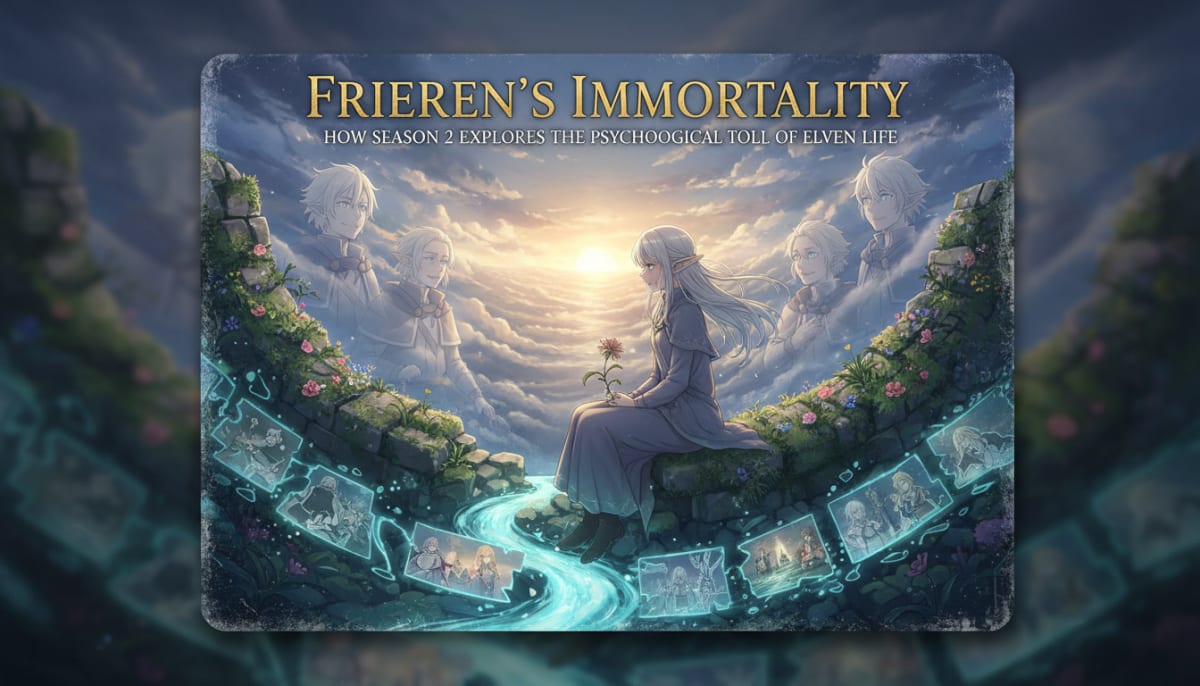
Frieren's Immortality: How Season 2 Explores the Psychological Toll of Elven Life
I watched Frieren: Beyond Journey's End Season 1 when it aired, and the moment that stuck with me wasn't a fight—it was the funeral. Frieren weeps at Himmel's grave, realizing she didn't try to "know" him during their ten years together. For her, a decade had felt like a week. I went back to the manga to understand what the series is really saying about elven life, and I realized that Frieren isn't "immortal" in the sense of being unkillable. She's biologically long-lived—spanning millennia—but she can still be killed by physical trauma or magic. The psychological toll comes from something else: time perception, delayed grief, and the weight of outliving everyone she cares about. In this guide, I break down how Frieren's immortality shapes her psychology, what the canon actually says about elves, and how Season 2 may deepen these themes.
If you've been following anime news 2026 or Frieren Season 2 updates, you know the series is officially confirmed for a second season (produced by Madhouse). As of this writing, there's no verified episode list or scene-by-scene breakdown for Season 2, so I'm grounding this in Season 1 and the manga—where the core psychological conflict is already fully established. Whether you're curious about how Frieren experiences grief differently, whether elves feel "less," or what the series says about time and attachment, this guide covers the canon evidence, the theme synthesis, and the common mistakes fans make when discussing Frieren's immortality.
Quick Navigation
Click to jump directly to a section:
- What "Immortality" Actually Means for Frieren
- Time Perception: Decades Feel Like Weeks
- Grief and Regret: Delayed-Onset Grief
- Memory and Ritual: Continuing Bonds
- Relationships Shaped by Time
- What Season 2 May Explore
- Common Mistakes About Frieren and Elves
- FAQ: Frieren's Immortality and Psychology
What "Immortality" Actually Means for Frieren
Before I get into the psychology, I need to clarify what the series actually says. I've seen a lot of misconceptions, so here's what's canon.
Life Span: Long-Lived, Not Unkillable
Elves in Frieren: Beyond Journey's End are biologically long-lived, spanning millennia, but they are not "immortal" in the sense of being unkillable. They appear to age at an incredibly decelerated rate (Manga Ch. 1 / Anime S1E1). Frieren has lived for over a thousand years—Flamme tells her she must "hide her mana" for a thousand years to defeat the Demon King (Anime S1E7)—but she's still mortal. I think this distinction matters. The psychological toll isn't about being invincible; it's about watching everyone else die while you keep going.
Vulnerability: She Can Be Killed
Frieren expresses caution regarding powerful mages and demons, and the manga states she has been defeated by mages with less mana many times (Manga Ch. 37 / Anime S1E21). She is not invincible. She can be killed by physical trauma or magic. I've seen people say "she's a god" or "she can't die," but that's not supported. Her longevity makes loss more frequent and more painful, but it doesn't make her safe.
Procreation and Extinction
Elves have extremely low reproductive instincts and drives, which—combined with the Demon King's past massacres—has led them to the brink of extinction (Manga Ch. 22 / Anime S1E14). The series also notes that elves have a "faded" sense of urgency, which humans often mistake for a lack of emotion. I think this is important: elves aren't emotionless; they process at a different speed and have different biological drives. That difference is what creates the psychological gap between Frieren and the humans around her.
Time Perception: Decades Feel Like Weeks
The core of Frieren's psychology is time perception. I've been analyzing the canon, and the evidence is consistent: for her, decades are trivial. In the very first episode, she leaves the party for 50 years to collect spells and returns surprised by how much Himmel has aged (Anime S1E1). She didn't think 50 years would change anything. In Episode 2, she spends over six months searching for the "Blue Moon Weed" in a single forest without concern for time (Anime S1E2). For a human, six months is a long commitment; for Frieren, it's a short errand.
I think this creates what I'd call a "psychological lag." She only processes the weight of a relationship after the human is gone. Ten years with the Hero Party felt like a week to her, so she didn't prioritize getting to know Himmel while he was alive. The urgency that humans feel—"I might never see this person again"—doesn't exist for her in the same way. By the time she realizes what she's lost, it's too late. That's the tragedy at the heart of the series: not that she doesn't care, but that she cares too late.
Grief and Regret: Delayed-Onset Grief
The funeral scene in Episode 1 is the clearest example of delayed grief. Frieren weeps at Himmel's grave, lamenting that she didn't try to "know" him during their ten years together (Anime S1E1). For her, the reality of his death only hits at that moment. The brevity of human life compared to hers means she often misses the chance to bond before they die. I've seen people say "Frieren doesn't feel anything," but that's not supported. She feels deeply—she weeps, she regrets, she carries guilt. It's the timing of her emotions that differs.
I think the series is saying something specific about immortality and grief. When you have centuries, you don't feel the same pressure to say the right thing today. You assume there will be more time. For Frieren, that assumption is wrong every time. By the time she visits Heiter on his deathbed (Manga Ch. 10), she accepts his "trickery" to make her stay longer—she's learned, a little, that human time is finite. But she still departs from Fern and Stark with only a brief wave in Episode 28 (Anime S1E28), mirroring her quick departure from the Hero Party. Old habits die hard, especially when you've had a thousand years to form them.
Memory and Ritual: Continuing Bonds
Because she outlives everyone, Frieren turns abstract memories into tangible rituals. I've been tracking how this shows up in the series. She receives a ring from Himmel (Anime S1E14); decades later, she learns the "Eternal Love" flower language and finally understands what it meant. She visits the village where she spent years cleaning a beach to find a flower Himmel once mentioned (Anime S1E12). She collects "useless" spells—like the one that creates a field of flowers—because they connect her to the past. These aren't just quirks; they're ways of maintaining "continuing bonds" with the deceased.
I think Himmel's statues are the strongest example. He posed for statues across the land so that Frieren wouldn't be alone in the future (Anime S1E12). He understood her time scale. The statues are a physical bridge across centuries, forcing her to confront his memory daily. The entire series is, in a sense, a ritual of remembering. She's not moving on; she's learning how to carry the past with her.
Relationships Shaped by Time
I've been analyzing how Frieren's immortality shapes each of her key relationships, and the pattern is clear: she was often a "passenger" during the Hero Party's quest. She only became an "active participant" in their lives after they died. That's the irony. The journey mattered to her in retrospect, not in the moment.
Himmel the Hero
Originally a ten-year blip in her life, Himmel's death becomes the catalyst for her entire current psychological journey (Anime S1E1). She didn't value those ten years while they were happening; she values them now that he's gone. I think that's why the funeral hits so hard. It's not just grief—it's the realization that she wasted the time she had.
Fern and Heiter
Frieren takes on Fern not out of desire, but as a "deathbed favor" to Heiter (Anime S1E2). Her sense of duty spans human lifetimes. With Fern, she has to manually remind herself that Fern doesn't have "centuries" to wait. She acts as a parental figure but struggles with the pace of Fern's growth. In Episode 4, she spends months cleaning a beach—initially just to pass time, but eventually for Fern's sake (Anime S1E4). That's empathy growth: she's learning to value the "now" because Fern is teaching her that the "now" is all humans have.
Flamme the Mentor
Frieren still follows Flamme's instructions a thousand years later (Anime S1E7). For an elf, a mentor's influence never truly "ages out." I think this shows how elven memory works: the past doesn't fade the way it does for humans. That can be a comfort—she still has Flamme's voice in her head—but it also means she carries a thousand years of instructions, losses, and regrets with her every day.
Kraft the Elf: Loneliness and Identity
In Manga Ch. 22, Frieren meets Kraft, another elf. They realize they are likely the only ones who remember their era. That scene is one of the best illustrations of elven loneliness. There's no one left who shares their time scale. Everyone they knew is dead; every human they meet will be gone in a blink. I think that's why the meeting with Kraft hits so hard—it's rare for Frieren to meet someone who understands what it means to outlive an entire world.
Identity: The Clone in the Dungeon
In Anime S1E25, Frieren faces a perfect magical clone of herself and reflects on her own cold, calculating nature as a mage. The clone is a "snapshot" of her magic and her emotional distance. I think the series is asking: is that coldness inherent to elves, or is it a defense mechanism? She's spent centuries avoiding deep bonds to prevent the pain of loss, but through Fern, she's beginning to value connection anyway. The clone forces her to see herself as others might see her—distant, efficient, slow to show emotion—and to question whether that's who she wants to be.
What Season 2 May Explore
Frieren Season 2 has been officially confirmed to be in production by Madhouse (as of official announcements). There is currently no verified release date or episode list for Season 2. Any claims about specific psychological scenes in Season 2 are unverified—so I'm not inventing episode breakdowns here. What we can do is point to where the manga goes next and what themes are set up for continuation.
If Season 2 adapts further manga content, it may explore the "Golden Land" / Macht arc (Manga Ch. 81–104), which contrasts elven longevity with the "immortality" of a demon's curse and memory. That arc goes deeper into how different beings experience time and malice over centuries. Later, Manga Ch. 117 has Frieren reflect on how human culture has fundamentally shifted since her childhood—another moment of empathy growth and the gap between elven and human experience.
You don't need Season 2 to understand the psychological toll of elven life. Season 1 and the early manga volumes already establish the core conflict: time perception, delayed grief, memory as ritual, and the struggle to attach when everyone you love will die before you've barely aged. Season 2 can deepen these themes, but the foundation is already there.
Common Mistakes About Frieren and Elves
I've seen these repeated often, so I'm listing them with corrections.
- "Elves are emotionless" / "Frieren doesn't feel anything": Not supported. She weeps, regrets, and carries guilt. She feels deeply; she simply processes at a different speed. (Evidence: Anime S1E1 funeral scene.)
- "Frieren is 1,000 years old": Supported. She has lived at least a millennium. (Evidence: Anime S1E7, Flamme's instruction.)
- "She cannot die" / "She is a god": Not supported. She explicitly fears certain magical threats and has been defeated by mages with less mana. (Evidence: Anime S1E21, Manga Ch. 37.)
- "She forgot Himmel": Not supported. The entire series is a ritual of remembering. (Evidence: ring, flowers, statues, journey itself.)
- "Elves feel emotions less": Not quite. They have lower "biological drives" (e.g. reproductive instinct), which humans mistake for lack of emotion. (Evidence: Manga Ch. 22.)
FAQ: Frieren's Immortality and Psychology
Is Frieren truly immortal?
No. She is biologically long-lived (likely thousands of years) but can be killed by magic or violence. She is not invincible.
Does immortality mean invincible in Frieren?
No. Frieren mentions she has been defeated by mages with less mana many times (Manga Ch. 37). She is vulnerable to physical and magical harm.
How does Frieren experience grief differently?
It is delayed. The brevity of human life compared to hers means she often realizes the value of a person only after they are gone. Ten years felt like a week, so the weight of loss only hits at events like Himmel's funeral.
Which scenes best show the psychological toll?
Himmel's funeral in Episode 1 and her meeting with the elf Kraft in Manga Ch. 22 (Anime S1E14 area). The funeral shows delayed grief; the Kraft scene shows elven loneliness and shared time scale.
Do I need Season 2 to understand this theme?
No. Season 1 and the early manga fully establish her time-dilated perspective, grief, memory rituals, and growth through Fern. Season 2 can expand on it but isn't required.
Are elves stated to feel emotions less?
No. They are stated to have less "drive" or "instinct" (e.g. reproductive), which is often mistaken for lack of emotion. Frieren feels regret, sadness, and attachment; her emotions are real, but her timing is different.
Conclusion: The Weight of Endless Time
Frieren's immortality isn't about power—it's about loneliness, delayed grief, and the difficulty of attaching when you know you'll outlive everyone. The series uses her elven lifespan to explore how time perception shapes relationships: she wasn't cold during the Hero Party's journey; she was operating on a scale where ten years felt trivial. By the time she understood what she had lost, it was too late. Through Fern, she's learning to value the "now"—to clean the beach for someone else's sake, to say goodbye properly (even when she still slips), and to let human urgency into her life.
If you've been following anime reviews, anime news 2026, or Frieren Season 2 updates, the psychological toll of elven life is one of the series' central themes. It's established in Season 1 and the manga, and it doesn't depend on invincibility or emotional coldness—it depends on time. Frieren feels; she just feels too late. The whole story is her learning to feel in time.
Last updated: March 2026 | Based on Frieren: Beyond Journey's End Season 1 and manga (Ch. 1, 10, 22, 37, 81–104, 117). Season 2 in production (Madhouse); specific S2 content unverified.