
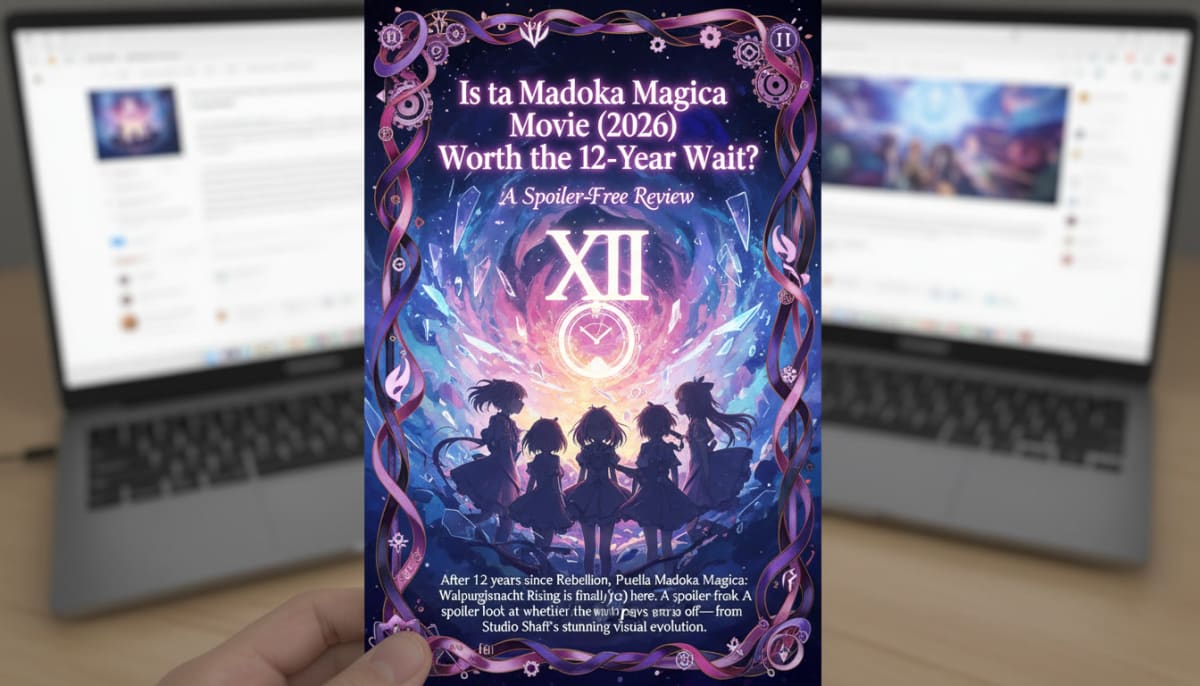
Is the Madoka Magica Movie (2026) Worth the 12-Year Wait? A Spoiler-Free Review
I still remember watching Rebellion in a packed theater in 2013. The credits rolled, the lights came up, and nobody moved. We had just watched Homura Akemi rewrite reality itself—and the film ended on a cliffhanger that would haunt fans for over a decade. Fast-forward to 2026, and Puella Magi Madoka Magica: Walpurgisnacht Rising (Walpurgis no Kaiten) is supposed to finally close that loop. But after delays that pushed it from 2024 to Winter 2025 and now to a February 2026 window—with a further indefinite delay announced in late January 2026 and a new date expected in mid-February—the question on everyone's mind is simple: Is it worth the wait?
This is a spoiler-free review. I won't touch plot twists or character fates. Instead, I'll break down what we know from trailers, early critical buzz, and the production itself: whether Walpurgisnacht Rising justifies 12 years of anticipation, how Studio Shaft's visual style has evolved, and whether this film deserves a spot on your anime movie 2026 watch list. If you've been following anime news 2026 or the latest anime movie news, you've probably seen the hype—and the frustration. Here's a clear-eyed look at both.
Quick Navigation
Click to jump directly to a section:
- The 12-Year Wait in Context
- Where Things Stand: Release Date & Delays
- What Critics Are Saying (Spoiler-Free)
- Studio Shaft's 15-Year Visual Evolution
- Worth the Wait? The Honest Take
- FAQ: Walpurgisnacht Rising
The 12-Year Wait in Context
Let's be real: the 12-year gap has turned Walpurgisnacht Rising into anime's answer to Silksong. A project so long-awaited it's reached almost meme status. The previous canonical entry, Rebellion, dropped in October 2013. Fans have lived with its controversial ending—Homura as a "Devil," Madoka's fate in the balance—for over a decade. Gen Urobuchi reportedly finished the script somewhere between 2014 and 2016, right after Kamen Rider Gaim. So the story has been sitting there, patient, while production caught up.
The film is the official fourth movie and a direct sequel to Rebellion. It ignores the Magia Record spin-off and stands as the main continuation of the core story. The full title—Puella Magi Madoka Magica the Movie: Walpurgisnacht Rising (劇場版 魔法少女まどか☆マギカ〈ワルプルギスの廻天〉)—signals the return of the legendary witch that defined the original 2011 series. For fans who have been waiting since 2013, this isn't just another anime sequel. It's the capstone to a trilogy that changed the magical girl genre forever.
Where Things Stand: Release Date & Delays
As of late January 2026, the film faced another indefinite delay due to production circumstances. A new date announcement was expected in mid-February 2026. Originally slated for 2024, then Winter 2025, then February 2026—the pattern is familiar. Shaft has a history of delaying theatrical releases to get things right (anyone remember the Negima Final situation?). Most fans have taken the delays in stride, preferring a finished work over a rushed one. That said, if you're tracking anime release dates or spring anime 2026, keep an eye on official channels for the updated premiere window.
The film runs approximately 120 minutes. It will have a theatrical-exclusive window first—so don't expect it on Crunchyroll or Netflix immediately. The original series and Magia Record are on Crunchyroll; this one will hit theaters first. If you want to prepare, the recommended watch order is: the original 12-episode series (Blu-ray version) followed by Movie 3: Rebellion. Nothing else is required.
What Critics Are Saying (Spoiler-Free)
Early buzz from trailers and "Revival Screenings" paints a clear picture: Walpurgisnacht Rising is darker, messier, and more complicated than what came before. Critics describe it as a "heady, stylish, and emotional culmination." The focus is squarely on the philosophical consequences of Homura's choices in Rebellion—what happens when you rewrite reality for love, and who pays the price.
Praise: The thematic depth gets consistent nods. The film doesn't shy away from the moral weight of Homura's actions. On the visual side, the shift to digital animation and 3DCG integration is being called "dazzling" and "avant-garde." Shaft has clearly invested in a new visual language for this project.
Criticism: Like Rebellion, some early viewers find it "slightly confusing" and "long"—it doesn't flow like a typical blockbuster. There's also a vocal contingent who feel the original 12-episode ending was "perfect" and that any continuation risks milking the franchise. Fair point. If you loved the TV series finale and never asked for more, Walpurgisnacht Rising might feel like an addendum. If you've been desperate for resolution since 2013, it's exactly what you've waited for.
Community discussion often circles the same question: Will Homura and Madoka finally achieve a "positive peace," or will their happiness be "torn from them until they're left with despair"? The trailers don't answer that. They do introduce new magical girls whose designs seem to be "amalgamations" of the main cast—sparking theories about merged timelines. All of that stays speculative until the film lands.
Studio Shaft's 15-Year Visual Evolution
For an art-focused site like this one, the 15-year evolution of Studio Shaft's style—from the experimental 2011 TV series to the high-budget 2026 theatrical finish—is one of the most compelling narratives. Here's what stands out.
From Analog "Roughness" to Digital Precision
The original 2011 series was famous for its "Shaft-isms": minimalist backgrounds, sudden color shifts, and the iconic head tilt. Characters were flat and cel-shaded against highly detailed but often static backgrounds. Lighting filters did a lot of heavy lifting to hide production constraints. The 2026 trailers show a real leap: characters feel integrated into their environments through advanced digital lighting and depth-of-field. The flatness of 2011 has been replaced by a cinematic weight. Complex 3DCG elements—like the rotating "Walpurgisnacht" gear motifs—blend seamlessly with 2D animation. Shaft has shifted almost entirely to digital drawing and developed a specialized 3DCG department for this film.
The Gekidan Inu Curry "Performance"
The witch labyrinths—the most striking visual element of Madoka Magica—were created by the duo Gekidan Inu Curry. Their early work used a scrapbook, collage style: stop-motion, paper textures, disturbing fairy-tale imagery. In Walpurgisnacht Rising, this has evolved into a "digital performance." Trailers feature higher-fidelity textures and more fluid movement within these spaces. Abstract imagery—the 18th Tarot Card (The Moon), glass statues, clara dolls, Greek statues—is rendered with a clarity that makes the surrealism feel more real, and more threatening, than the grainy textures of the original. Doroinu (one half of Gekidan Inu Curry) handles the witch spaces, so the signature collage aesthetic remains even as the tech upgrades.
Symbolism & Color Palette
Color acts as character. The 2011 series used bright, saturated tones to contrast the dark plot. The 2026 trailers lean into a more monochromatic, muted palette. There's a stark contrast between Homura (darkness, purple) and Madoka (light, pink)—symbolizing their inverted roles since Rebellion. Worth noting for art analysis: the recurring bandages on Sayaka and the shattered mirror imagery read as visual metaphors for the "broken" world Homura created. It's not just pretty; it's deliberate.
The "Shinbo Style" Grows Up
Chief Director Akiyuki Shinbo has spent the last decade refining his style across the Monogatari series and Kizumonogatari. The new film moves away from the TV series' static, stage-play framing toward more dynamic, sweeping camera movements. That isn't just "better animation"—it's a shift in how the studio uses the cinematic frame to convey psychological distress. For a drawing and art-focused audience, that's the real story: technique in service of theme.
On the sound side, Yuki Kajiura returns as composer. Her work here is described as heavy on "cognitive dissonance" and mood—essential for the series' trademark tension. The music does a lot of emotional heavy lifting when the visuals hold back.
Worth the Wait? The Honest Take
Why it might be: The original Magica Quartet is back to resolve a 13-year-old cliffhanger with modern production values. Gen Urobuchi, Akiyuki Shinbo, Ume Aoki, and the core team are all involved. The animation has evolved in ways that honor the original while pushing into new territory. If you care about Homura and Madoka's story, this is the payoff. It's often compared to Evangelion 3.0+1.0—a decade-later resolution that has to balance nostalgia with a meaningful ending. Early signs suggest Shaft is aiming for that balance.
Why it might not be: Some viewers will always prefer the 2011 series finale. For them, Rebellion and Walpurgisnacht Rising are unnecessary layers. The film is long, dense, and reportedly confusing at times. If you're not already invested, the 12-year buildup might set expectations so high that nothing could meet them. And the delays—as understandable as they are—have tested patience.
My take: If you've been waiting since 2013, you've already decided. This film exists for you. For newcomers, watch the series and Rebellion first. If that ending haunts you the way it haunted so many of us, Walpurgisnacht Rising is worth the wait. It may not be perfect—few things are after 12 years of hype—but it's the resolution the story has been building toward. And as a piece of animated art, the evolution of Shaft's craft alone makes it a notable anime movie 2026 release.
2026 also marks renewed franchise activity: the mobile/PC game Madoka Magica: Magia Exedra launched in 2025, and the TV Edition of the compilation films aired to prep audiences. Whether the movie finally lands in February or slips again, the ecosystem around it is alive. That counts for something.
FAQ: Walpurgisnacht Rising
Do I need to watch Rebellion first?
Yes. This is a direct sequel. The film continues immediately from Rebellion's ending. Skip it and you'll be lost.
Is Walpurgisnacht Rising canon?
Yes. It's the official continuation of the main story written by Gen Urobuchi. Magia Record and other spin-offs are separate.
How long is the movie?
Approximately 120 minutes.
Is it on Crunchyroll?
Not yet. The original series and Magia Record are on Crunchyroll. Walpurgisnacht Rising will have a theatrical-exclusive window first. Streaming details will follow the theatrical run.
Who is the new character in the trailers?
Trailers reveal new magical girls whose designs seem to be "amalgamations" of the main cast. Theories about merged timelines are circulating, but specifics remain unconfirmed until release.
Why has the film been delayed so many times?
Production circumstances at Studio Shaft. The team has emphasized quality over speed—and Shaft has a history of delaying theatrical releases to avoid shipping incomplete work. Most fans have accepted the trade-off.
Conclusion: Patience (Maybe) Rewarded
Puella Magi Madoka Magica: Walpurgisnacht Rising is the film fans have waited 12 years for. Whether it's "worth it" depends on what you want: a neat resolution, thematic depth, or simply to see Homura and Madoka's story continue. Early critical buzz suggests a darker, messier, and more ambitious film than Rebellion—one that doesn't shy away from the consequences of its predecessor's ending.
For art and animation lovers, the real draw is watching Studio Shaft evolve from the rough, experimental 2011 look to a polished digital finish that still carries the DNA of Gekidan Inu Curry's witch spaces and Shinbo's distinctive direction. That alone makes it a noteworthy entry in anime movie news 2026.
The delays are frustrating. The hype is immense. But if you've been here since Rebellion, you already know the answer. Sometimes the wait is the point. And when the new date finally lands, we'll be in that theater again—hoping the lights stay off a little longer this time.
Last updated: February 2026 | Walpurgisnacht Rising release date TBD; check official channels for updates