
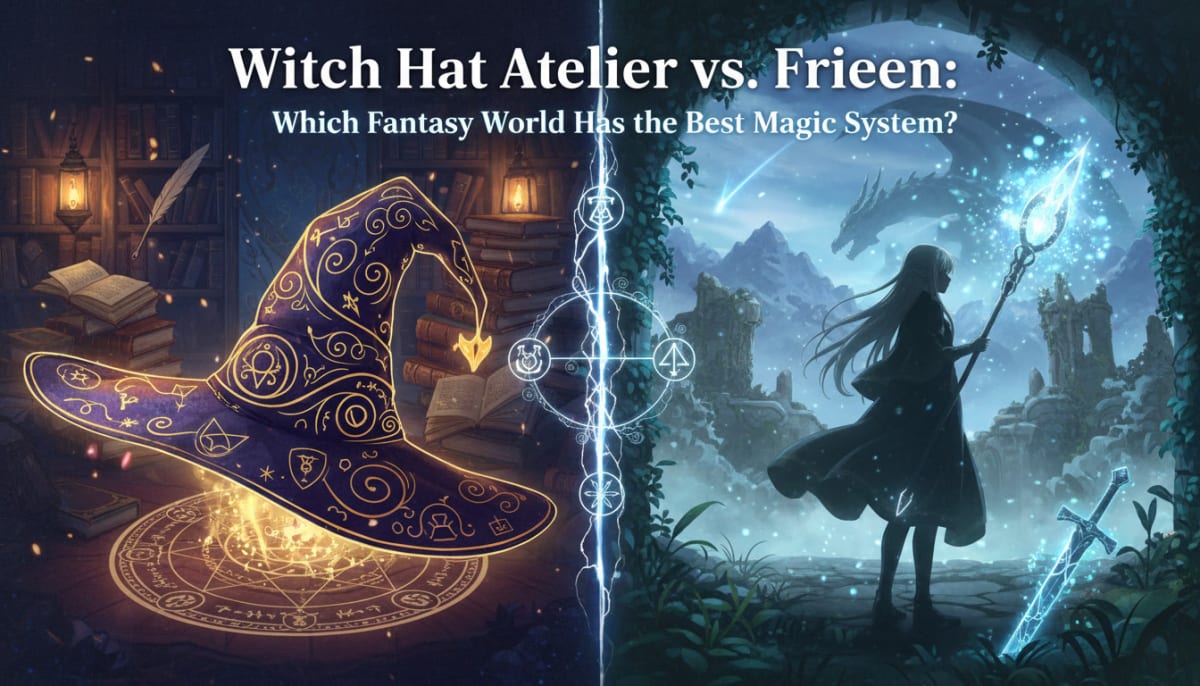
Witch Hat Atelier vs. Frieren: Which Fantasy World Has the Best Magic System?
Both Witch Hat Atelier by Kamome Shirahama and Frieren: Beyond Journey's End by Kanehito Yamada represent the gold standard of modern fantasy, yet they approach magic from opposite ends of the spectrum. One treats magic as a precise, tactile craft; the other treats it as a fluid, philosophical art form. In this deep-dive we break down how each system works, how they compare, and—depending on what you value in a story—which fantasy world has the best magic system. If you follow anime reviews, manga anime news, or anime blog coverage of fantasy series, this is the comparison you've been waiting for.
Quick Navigation
Click to jump directly to a section:
- Witch Hat Atelier: The Art of the Ink
- Frieren: The Power of Visualization
- Structured Comparison
- Thematic Fit
- Strengths and Weaknesses
- Key Angles and Hot Takes
- FAQ
- Conclusion
Witch Hat Atelier: The Art of the Ink
In the world of Coco and her peers, magic is fundamentally graphical. It is not an internal energy, but a universal force harnessed through specific symbols.
How It Works
Magic is "drawn" using Magic Ink and a Keystaff (a pen). A spell consists of three parts: the Circle (the boundary), Keystones (the elemental core), and Arrows (modifiers for direction, size, and intensity). Precision and draftsmanship directly determine the spell's power and reliability.
The Big Secret
The world believes magic is innate—something you are born with. In reality, anyone can do it if they know how to draw the symbols. This secret is protected by the Knights of Moralis to prevent the return of "Forbidden Magic" and the chaos that would follow if magic were democratized.
Rules and Limitations
The spell's power is limited by the precision of the drawing and the quality of the ink. Once the circle is closed, the spell activates. You cannot change a spell once it is drawn. If a circle is smudged or misdrawn, the spell fails—the physics are tactile and absolute.
Cost and Risk
The primary risk is "ink-staining" or accidental activation. If a spell is drawn on a human body, it becomes permanent and often horrific (Forbidden Magic), leading to the strict prohibition of medical or biological magic. The system is built on societal and ethical stakes: the fear of what "anyone" could do with a pen.
Frieren: Beyond Journey's End — The Power of Visualization
Magic in Frieren is more traditional in appearance but deeply psychological in execution.
Sources of Magic
Magic is fueled by Mana, an internal energy source. Mages can detect, hide, and manipulate this energy. Capacity and control vary by individual and decades of training.
The Visualization Rule
The core law of this world is: "You cannot manifest what you cannot visualize." If a mage cannot truly conceive of a shield breaking, they can never break it, regardless of their mana levels. Imagination and mental clarity are as important as raw power.
Training and Specialization
It takes decades of study. Mages like Fern specialize in "ordinary" magic (e.g. Zoltraak) perfected through speed and efficiency, while others like Land or Ubel use magic that reflects their specific psychological quirks. Magic is an extension of the mage's personality and ego.
Limitations
Magic is bound by logic and perception. As humanity deconstructs "Demon Magic" into "Human Magic," spells that once seemed like miracles become mundane tools. The system is iterative: spells evolve over centuries (e.g. the history of the Killing Magic), giving the world a sense of immense historical depth.
Structured Comparison
Side-by-side, the two systems diverge in type, expression, consistency, and stakes.
| Feature | Witch Hat Atelier | Frieren: Beyond Journey's End |
|---|---|---|
| Magic Type | Hard Magic. Highly logical, mechanical, and rule-bound. | Semi-Hard Magic. Rules exist, but "Visualization" allows for soft, emotional peaks. |
| Expression | Creative Engineering. Solving problems by combining shapes—like coding. | Psychological Projection. Magic is an extension of the mage's personality and ego. |
| Consistency | Absolute. If a circle is smudged, it fails. The physics are tactile. | Iterative. Spells evolve over centuries; history and legacy shape what is possible. |
| Stakes | Societal and ethical. The fear of what "anyone" can do with a pen. | Tactical and existential. The battle of mana capacity and mental fortitude. |
Thematic Fit
Witch Hat Atelier uses magic to explore accessibility and ethics. Because magic is an art form anyone can learn (in secret), the story focuses on the burden of knowledge and the gatekeeping of "talent." The Knights of Moralis and the lie of innate magic make the world's gatekeeping one of the most realistic—and unsettling—fantasy tropes.
Frieren uses magic to explore time and legacy. Magic is a record of history; a spell created by a master 80 years ago is the bridge through which Frieren connects with her past. When Frieren wins, it's often because she understands a concept—or a person—better than her opponent. The system serves themes of memory, longevity, and what we leave behind.
Strengths and Weaknesses
Witch Hat Atelier
- Strength — Ingenuity: Readers can actually "solve" puzzles alongside Coco because we understand the grammar of the circles. The "Aha!" moments are incredibly satisfying.
- Strength — Visual Wonder: The art of the manga is inseparable from the magic. The spells are beautiful, intricate diagrams.
- Weakness — Complexity: The sheer detail of the drawing rules can occasionally slow down the pace of action scenes.
Frieren: Beyond Journey's End
- Strength — Emotional Resonance: The "Visualization" rule allows for poetic victories. Wins feel earned through understanding, not just power levels.
- Strength — Historical Depth: Seeing how magic "ages" (from terrifying demon spells to standardized "Basic Magic") gives the world immense scale.
- Weakness — Vague Power Scaling: Because it relies on visualization, it can sometimes feel like a character wins simply because they "wanted it more," bordering on shonen "power of friendship" logic.
Key Angles and Hot Takes
These hooks work well as discussion starters or subheadings in anime reviews and anime blog posts:
- "Witch Hat Atelier is Science in Disguise": The drawing system is essentially a programming language—circles, keystones, arrows—making it one of the most logical magic systems in modern fiction.
- "In Frieren, Imagination is the Only Stat That Matters": A mage with low mana can defeat a master simply by having a "sturdier" mind or a clearer visualization.
- "The Pen vs. The Mind": Coco's external tools (ink, keystaff) make her vulnerable in the open; Frieren's internal power makes her a walking catastrophe. Different vulnerabilities, different tensions.
- "Why Witch Hat's Gatekeeping is the Most Realistic Fantasy Trope": The Knights of Moralis and the ethics of "democratizing" magic mirror real-world debates about knowledge, power, and who gets to decide.
FAQ
Which has the "best" magic system?
It depends on what you value. Witch Hat Atelier wins on system design—mechanical depth, puzzles, and consistency. Frieren wins on thematic execution—magic as memory, legacy, and the human condition.
Do I need to know both series to enjoy this comparison?
No, but it helps. The overviews above summarize how each system works; if you've only seen Frieren (anime) or only read Witch Hat (manga), you can still follow the comparison and decide which system appeals to you more.
Is Witch Hat Atelier getting an anime?
Yes. Witch Hat Atelier has been announced for anime adaptation. For anime adaptation news and anime release dates, follow official channels and anime news 2026 for updates.
Where can I watch or read Frieren?
Frieren: Beyond Journey's End is available on Crunchyroll and other streaming services. The manga is available in English. For anime streaming news and netflix anime news, check your region for availability.
Which is better for beginners—Witch Hat or Frieren?
Frieren's anime is very accessible and often recommended in anime reviews and best anime lists. Witch Hat is manga-first; its magic system is denser but deeply rewarding for readers who like puzzle-box worldbuilding.
Conclusion
While both systems are masterpieces of worldbuilding, the "best" system depends on what you value in a story. If you crave mechanical depth and intellectual puzzles, Witch Hat Atelier is unrivaled; it invites you to pick up a pen and join the world. If you prefer magic as a metaphor for the human condition—where a spell is a memory and mana is a legacy—Frieren reigns supreme. Ultimately, Witch Hat wins on system design, but Frieren wins on thematic execution. Whichever you prefer, both belong at the top of any fantasy anime or manga anime news recommendation list.
Last updated: March 2026 | Witch Hat Atelier (manga, anime announced); Frieren: Beyond Journey's End (manga, anime available).