
Content note: This article discusses sensitive themes including terrorism, radicalization, and violence as portrayed in The Darwin Incident. Reader discretion is advised.
Why 'The Darwin Incident' Is the Most Controversial Anime of 2026
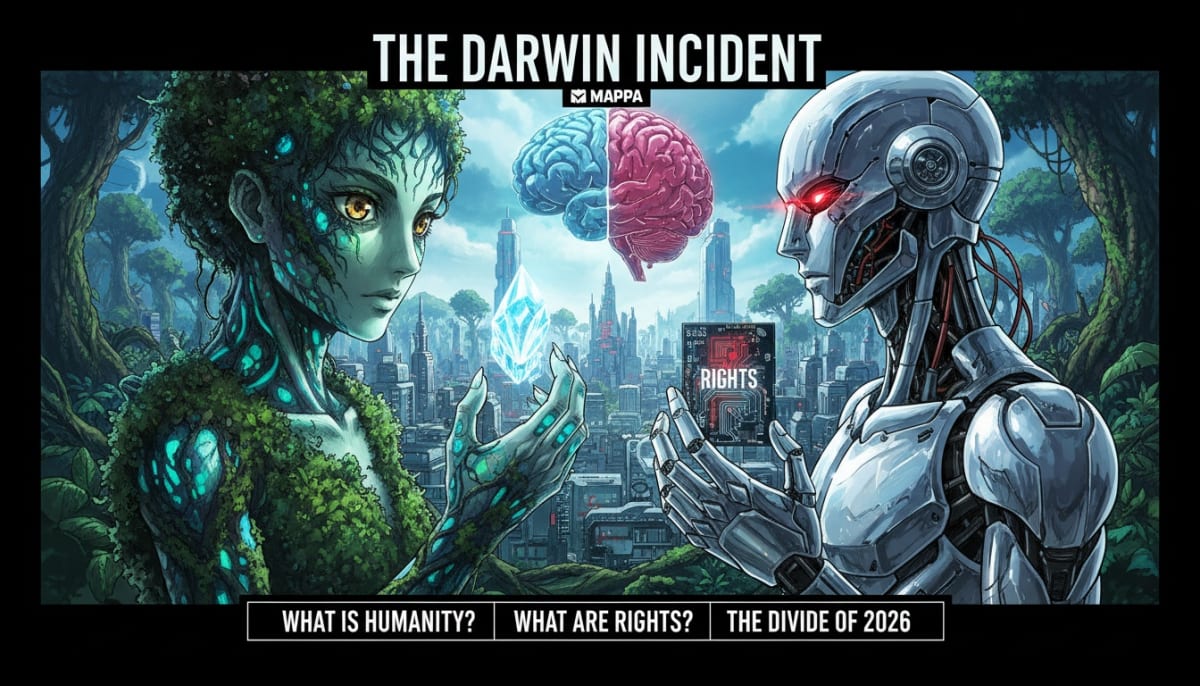
We're covering this not because it's easy to watch, but because it might be the most important conversation happening in the medium right now. The Darwin Incident (Darwin Jihen / ダーウィン事変) isn't the most controversial anime of 2026 because it's the bloodiest—Chainsaw Man and others have that covered—or because it exposes industry darkness like Oshi no Ko. It's controversial because it asks you to sit with uncomfortable questions: What does "human" mean when biology can be engineered? Do "human rights" extend to someone who is literally half chimpanzee? And when extremists claim to fight for the oppressed while committing mass violence, who is the villain?
MAPPA's adaptation of Shun Umezawa's award-winning manga premiered in Winter/Spring 2026 and landed on Netflix as a global prestige release. The discourse started the moment it was announced (fans worried about MAPPA overworking staff), spiked at Episode 1 (the "vegan terrorist" angle), and exploded at the mid-season climax. Audiences are sharply divided. This piece breaks down why—without spoiling the story—and why the series challenges viewers in a way that goes beyond typical anime news 2026 headlines.
Quick Navigation
Click to jump directly to a section:
- What Is The Darwin Incident?
- Where the Controversy Comes From
- The Arguments: Critics vs. Defenders
- Why It Hits Different in 2026
- The Art of Charlie: Design and "Uncanny Valley"
- FAQ: The Darwin Incident
What Is The Darwin Incident?
The Darwin Incident is a 12-episode TV anime produced by MAPPA, directed by Naokatsu Tsuda (known for JoJo's Bizarre Adventure), and based on the manga by Shun Umezawa, serialized in Kodansha's Monthly Afternoon. It premiered in Winter/Spring 2026 and is distributed globally via Netflix—the standard for high-concept, prestige seinen.
The story follows Charlie, a "Humanzee": a half-human, half-chimpanzee hybrid born in a laboratory and raised by human parents. After fifteen years in seclusion, he starts attending a local high school, where he meets Lucy, a brilliant but socially isolated girl. The central conflict comes from the Animal Liberation Alliance (ALA), a radical group that treats Charlie as a symbol and uses increasingly violent tactics—eco-terrorism, what some characters call "vegan terrorism"—to advance their cause. Charlie is caught between a human world that sees him as a freak or a tool, and a movement that claims to fight for him while causing mass casualties. The series doesn't offer easy answers. It forces the viewer to sit in that tension.
Where the Controversy Comes From
The controversy isn't just about blood. It's about ideology vs. reality.
Political Sensitivity
The ALA echoes real-world extremist groups. Their rhetoric—eco-terrorism, animal liberation, "speciesism"—touches hyper-polarized debates around animal rights and environmental activism. Some viewers feel the show caricatures activists and delegitimizes real movements; others argue it's holding a mirror up to how any cause can be twisted into violence. The series challenges the viewer to sit with that ambiguity.
The "Humanzee" Concept
Charlie's existence is deliberately uncomfortable. Some find the biological premise uncanny or grotesque; others see the allegories for race, disability, and minority status as too on-the-nose or potentially mishandled in a Japanese context. Charlie isn't a cute anthropomorphic animal—he's drawn and animated to sit in the uncanny valley. That choice is intentional and divisive.
Grounded Violence
Unlike fantasy or shonen violence, the harm here is grounded: domestic terrorism, school-related threats, mass casualties. For Western audiences especially, that hits closer to home. MAPPA's adaptation leans into the horror of these sequences. Some manga readers feel the anime sensationalizes the violence for engagement; defenders say it's unflinching honesty. Audiences are sharply divided on whether the show earns its darkness.
The Arguments: Critics vs. Defenders
To keep this useful, here's how the debate usually breaks down.
Critics and Negative Reactions
- Both-sides-ism: The show is accused of portraying animal-rights activists as caricatured villains, potentially undermining real environmental and ethical movements.
- Tone discordance: The shift from high-school slice-of-life to bloody geopolitical thriller feels jarring or poorly paced to some.
- Moral ambiguity: Charlie's stoicism—he often refuses to take a clear moral stand—frustrates viewers who want a hero to root for. Some read it as nihilism.
Defenders and Positive Reactions
- Unflinching honesty: Fans praise the series for not sanitizing the ugly side of activism or the hypocrisy of human society. It doesn't preach; it interrogates.
- Character depth: Charlie is hailed as a truly unique protagonist. He doesn't think like a human, and the anime captures his "alien" logic—his priorities, his silence, his physicality—in a way that feels earned.
- Production quality: MAPPA's cinematic direction and realistic character designs (no moe shortcuts) elevate the mature themes. The anime looks like prestige TV.
Aggregate scores reflect the split: the series sits around an 8.1 on MyAnimeList with a high standard deviation—lots of 10s and lots of 1s. Influencers have compared it to Joker (2019): a "dangerous" watch that sparks more debate than comfort. Online, you'll see #CharlieDidNothingWrong and #ALAWasRight in the same thread. Charlie's blank, staring face has become a reaction meme for being "done with humanity." The discourse is the point.
Why It Hits Different in 2026
The 2026 social climate matters. Post-pandemic geopolitical tensions and the visibility of radical activism—from every side—make the ALA's twisted "logic" feel uncomfortably relevant. The series doesn't have to name real groups to land.
Comparisons that come up: Beastars also uses animals to discuss prejudice and hierarchy, but The Darwin Incident is more grounded and explicitly political. Attack on Titan shares themes of radicalization and the cycle of violence—who becomes a monster, and why. If you like prestige anime that refuses to tidy up morality—Monster, Vinland Saga—this is in that lane. It isn't a "vegan anime"; it uses radical veganism as a plot device for a terrorist organization, which is itself a major point of debate.
Manga vs. anime: the anime stays very faithful to the award-winning source material but, in true MAPPA style, leans harder into the visceral impact of the terrorist attacks. Whether that's sensationalism or honest adaptation is part of the argument.
The Art of Charlie: Design and "Uncanny Valley"
For an art-focused site, Charlie's design is worth a closer look. Unlike typical anthropomorphic characters, he isn't "human with animal ears" or "cute chimp." He's built to sit in the uncanny valley: human enough to read as a person, animal enough to make that reading uneasy. His proportions, his expressions, and his movement—blending human posture with ape-like agility—are a deliberate choice. MAPPA's team uses a mix of 2D and 3D to sell his weight and physicality; his stillness reads as control, his bursts of motion as something not quite human. It's a masterclass in character design that serves theme: Charlie is never allowed to be "just a guy," and the animation never lets you forget it. If you're interested in how anime tackles "otherness" through form, not just dialogue, Charlie is a case study.
FAQ: The Darwin Incident
What is The Darwin Incident about?
A thriller about Charlie, the first human-chimpanzee hybrid, navigating a world of human prejudice and radical animal-rights terrorism. He's claimed as a symbol by the violent Animal Liberation Alliance while trying to live an ordinary life with his friend Lucy.
Why is it controversial?
It deals with eco-terrorism, speciesism, and moral ambiguity in ways that parallel real-world political movements. The violence is grounded (terrorism, school threats), and the series refuses to clearly side with any faction. That makes some viewers uncomfortable and others engaged.
Is it worth watching?
Yes, if you enjoy prestige, morally complex anime like Monster or Vinland Saga. It's not comfort viewing. Content warnings: graphic violence, terrorism, implied and shown animal cruelty, and intense psychological themes.
How does the anime compare to the manga?
The anime is more visually visceral but remains very faithful to the award-winning source. MAPPA amplifies the horror of key sequences; some manga fans feel it crosses into sensationalism.
Who is Charlie?
Charlie is a "Humanzee"—a biological hybrid with human-level intelligence and superior ape-like strength. He was born in a lab and raised by human parents, then enters high school after years in seclusion.
Is it a "vegan" anime?
No. It uses radical veganism and animal liberation as the ideology of a terrorist organization. The show doesn't endorse that ideology; it uses it to explore how causes can be weaponized. That distinction is a major point of debate.
Where can I watch it?
Netflix, globally. It's part of the platform's 2026 anime lineup for high-concept, mature seinen.
Conclusion: The Conversation Is the Point
The Darwin Incident is the most controversial anime of 2026 not because it's the goriest or the most shocking, but because it forces a philosophical question: In a world of biological engineering and political extremism, what do "humanity" and "rights" even mean? It doesn't answer. It interrogates. That's why the discourse is so loud—and why, for viewers who can sit with discomfort, it's one of the most important shows of the year.
If you've been following anime news 2026, Netflix anime releases, or MAPPA's slate, you've already seen the headlines. The real question isn't whether the series is "good" or "bad"—it's whether you're willing to be challenged. For anyone interested in how anime can tackle political extremism, identity, and violence without easy outs, The Darwin Incident is essential, difficult viewing.
Last updated: February 2026 | The Darwin Incident streams on Netflix | Content warnings: violence, terrorism, psychological themes