
Akane Banashi Anime: Release Date, Rakugo Explained & Complete Guide (2026)
Weekly Shonen Jump's most unique series is coming to anime in 2026. Akane Banashi brings traditional Japanese rakugo to the world of shonen manga and anime, following 17-year-old Akane Osaki as she navigates the competitive, male-dominated world of rakugo to avenge her father's unjust expulsion. This comprehensive 3,000+ word guide covers everything you need to know about the Akane Banashi anime, from release dates and streaming platforms to detailed rakugo explanations, character analysis, and why this series represents a groundbreaking moment for Shonen Jump.
Whether you're completely new to rakugo or a longtime fan of the manga, this guide provides essential cultural context, detailed character profiles, and expert insights into what makes Akane Banashi special. We'll explore the traditional art of rakugo, Akane's journey from amateur to professional performer, the confirmed anime production details, and why this series has been praised as one of the most culturally significant manga in recent years. This is your complete resource for understanding why Akane Banashi is being called Shonen Jump's most unique and important new hit.
Why Akane Banashi Matters: Tradition Meets Modern Storytelling
Akane Banashi represents a revolutionary moment in Weekly Shonen Jump's history. In a magazine known for action-packed series like One Piece and Jujutsu Kaisen, Akane Banashi stands out as a character-driven drama focused entirely on a niche, traditional Japanese cultural art form. The series has been praised for its mature storytelling, excellent illustrations, and its ability to make the esoteric art of rakugo engaging and accessible to a new, young audience both in Japan and internationally.
For anime fans, the 2026 adaptation promises to bring this unique story to life with high-quality animation and voice acting. For newcomers to rakugo, this guide will help you understand what makes this traditional art form so special and why Akane Banashi has sparked renewed interest in attending live performances. This is more than just an anime adaptation—it's a cultural bridge between traditional Japanese art and modern global audiences.
Quick Navigation
Click to jump directly to a section:
- 1. What is Rakugo? Cultural Explanation for Newcomers
- 2. Manga Overview: Plot, Characters & Themes
- 3. Anime Adaptation Info: Release Date, Studio & Staff
- 4. Character Profiles: Akane, Rivals & Supporting Cast
- 5. Why It's Unique: Standing Out in Shonen Jump
- 6. Rakugo Performances Explained: How the Art Works
- 7. Themes & Philosophy: Dedication, Tradition & Performance Art
- 8. Manga Reading Guide: Where to Read & Chapter Count
- 9. Anime Expectations: Adaptation Challenges & Potential
- 10. Where to Watch: Streaming Platform Predictions
- 11. FAQ: Common Questions
- 12. Future Outlook: Series Potential & Cultural Impact
1. What is Rakugo? Cultural Explanation for Newcomers
Before diving into Akane Banashi, it's essential to understand what rakugo is and why it holds such significance in Japanese culture. Rakugo (落語; literally "fallen words" or "story with a fall") is a traditional Japanese verbal entertainment where a single storyteller, or rakugoka, sits on a raised stage and tells a long, often humorous, story that ends with a punchline called an ochi or sage.
The History of Rakugo
Rakugo has deep historical roots, originating from humorous anecdotes (called setsuwa) used by 9th and 10th-century Buddhist monks to make their sermons more engaging. However, it truly developed into a popular form of entertainment for the common people during the Edo period (1603–1867), performed in dedicated theaters called yose. Rakugo offers a window into the everyday life, customs, and humor of that era, preserving cultural traditions while entertaining audiences.
Today, rakugo remains a very much alive and popular art form in modern Japan, enjoyed by people of all ages. Traditional yose theaters still operate daily in major cities like Tokyo and Osaka, with famous performers like Tatekawa Shinosuke, Katsura Bunshi VI, and Hayashiya Shōzō IX continuing the tradition. Some Westerners, like the Canadian Katsura Sunshine, also perform in both Japanese and English, helping to globalize the art form.
How Rakugo Works: The Performance Format
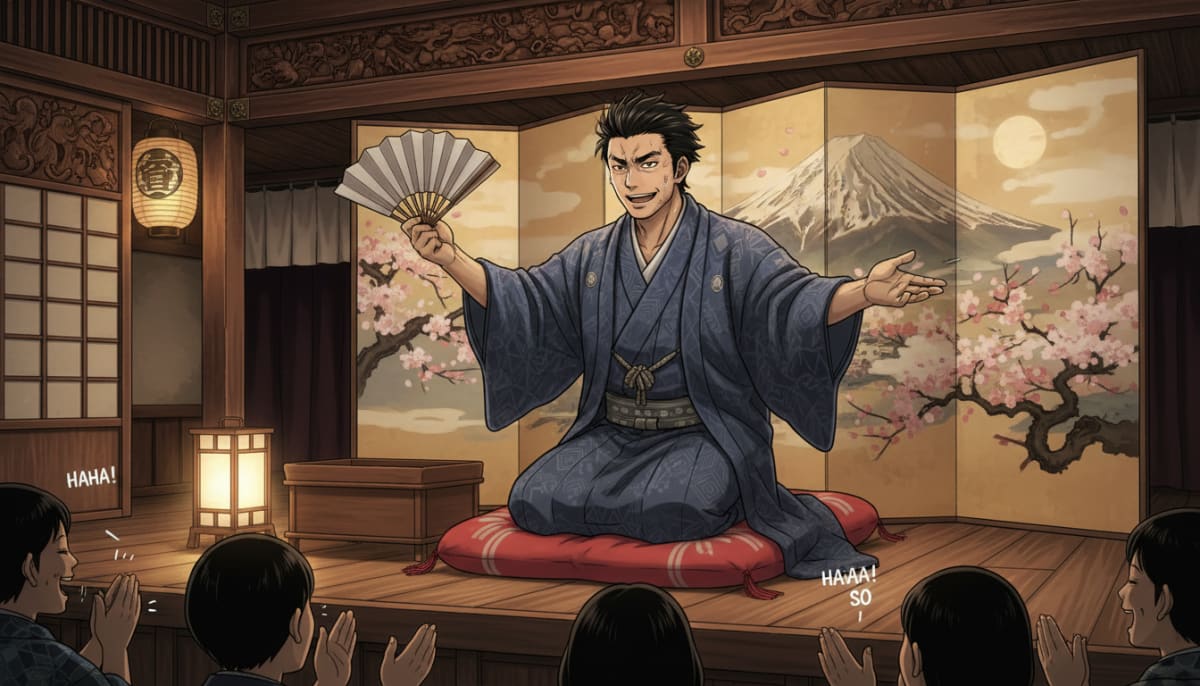
Rakugo is a minimalistic art form that relies heavily on the performer's skill and the audience's imagination. The performer remains seated in a seiza position on a cushion (zabuton) throughout the entire performance, using only two props: a folding fan (sensu) and a hand towel (tenugui).
The performance is usually structured with a casual monologue called a makura (or "pillow") to warm up the audience before transitioning into the main story (hanashi), which concludes with the ochi (punchline). Stories typically last from around 10 minutes to over an hour, varying by the story and the performer's style.
The Art of Storytelling
What makes rakugo truly remarkable is how the rakugoka portrays multiple characters, distinguishing them only through changes in pitch, tone, intonation, posture, and a subtle turn of the head. The sensu can represent objects like chopsticks, a pipe, or a pen, while the tenugui might be a wallet, a book, or a letter. Performers use specific gestures (shigusa), different eye levels (looking down for a child, up for an adult), and hand positions to embody various characters, from old men to young women, with no elaborate costumes or scenery.
The intimate setting of yose theaters encourages a close connection between performer and audience. The performer uses the makura to gauge the audience's mood and often improvises, creating a lively, interactive atmosphere. A good performance involves a deep understanding of rhythm, comedic timing, expressive gestures, and the ability to transport the audience into the world of the story through imagination.
Rakugo Schools and Traditions
Rakugo developed into two main traditions: Edo Rakugo (Tokyo style), known for being subtle and refined, and Kamigata Rakugo (Osaka/Kyoto style), which uses a dialect, is more expressive, and historically utilized small clappers (kobyoshi) and a small desk (kendai) on stage.
The art is passed down through a strict master-apprentice system. Aspiring rakugoka become live-in apprentices (zenza) to a master, performing menial chores for years before being allowed to perform simple stories. There is a strict hierarchy: zenza (opening act), futatsume (second rank/semi-professional), and shin'uchi (master headliner). Only shin'uchi masters can take on their own apprentices.
Famous Rakugo Stories
There are hundreds of traditional rakugo stories. One of the most famous is "Jugemu" (Jugemu Jugemu Gokōnosurine...), known for a character with an absurdly long name that is often used in training for new performers. Other classics include "Manju Kowai" (Manju Are Scary), a humorous tale about sweet buns, and "Shibahama", a story about a gambler's wife finding lost money—a story that plays a crucial role in Akane Banashi.
2. Manga Overview: Plot, Characters & Themes
Akane Banashi is a coming-of-age competitive drama manga written by Yuki Suenaga and illustrated by Takamasa Moue. The series has been running in Weekly Shonen Jump since 2022, with over 180 chapters as of late 2025. It has been a critical darling, nominated for the 69th Shogakukan Manga Award and placing 3rd in the 2023 Manga Taishō award.
The Main Plot
The story follows Akane Osaki, a 17-year-old high school girl, six years after her father, Shinta Arakawa, and all his peers were unjustly expelled from the prestigious Arakawa School during their shin'uchi promotion test by the strict head master, Issho Arakawa.
Fuelled by her love for the art her father performed and her anger over his unfair expulsion, Akane vows to become a top rakugoka (specifically aiming for the shin'uchi rank) to prove that her father's art was worthy of the title and to restore his honor. She faces a steep learning curve in a traditional, highly hierarchical, and primarily male adult world, overcoming skepticism about her age, gender, and brash style while learning the nuanced rules and etiquette of a centuries-old art form.
Major Story Arcs
The manga has progressed through several major arcs:
- Intro Arc: Establishes Akane's motivation and entry into the rakugo world
- Karaku Cup Arc: An amateur tournament where Akane competes with future key rivals like Karashi and Hikaru
- Zenza Renseikai Arc: Akane's intense training as a zenza (opening act performer)
- Four-Person Event Arc: Further development of Akane's skills and relationships
- Futatsume Debut Event Arc: The start of her time as a futatsume (second-rank performer)
- Arakawa School Past Arc: Delving into the history of the Arakawa School masters and the events surrounding her father's expulsion
- Zuiun Prize Arc: A current major competition arc
Setting and World
The story is set in modern Japan. Akane navigates real-world locations like high school, traditional yose theaters in Tokyo (like Shinjuku Suehirotei), and the internal workings of the fictional but realistically-depicted Arakawa school organization. The manga vividly portrays the hierarchical structure and the inner workings of the rakugo community, providing an authentic look at how this centuries-old guild system functions today.
Cultural Significance
Akane Banashi is considered culturally significant for making the traditional, yet little-known, art of rakugo accessible to a wider, younger audience both in Japan and internationally. The manga has sparked a renewed interest in rakugo and serves as an educational tool, with the rakugoka consultant Keiki Hayashiya ensuring accuracy and providing supplementary material. The series showcases specific cultural elements, stories, and the rigid hierarchy of the rakugo world, acting as a "time capsule" of Japanese tradition while exploring modern social dynamics like gender roles.
3. Anime Adaptation Info: Release Date, Studio & Staff
The Akane Banashi anime was officially confirmed on August 4, 2025, with the announcement coming via an official website launch, a teaser trailer, and key visuals. The anime is scheduled for a 2026 broadcast in Japan on the TV Asahi network's IMAnimation block and BS Asahi. An exact premiere date (month and day) has not been specified yet, but more information is expected at the Jump Festa 2026 event in December 2025.
Animation Studio: Studio Zexcs
The anime is being produced by Studio Zexcs, known for series such as Shōnen Maid, Diabolik Lovers, and Frame Arms Girl. However, the involvement of director Ayumu Watanabe (known for the critically acclaimed Summer Time Rendering and the upcoming Witch Hat Atelier) indicates strong potential for high-quality direction and atmosphere.
Confirmed Production Staff
The key staff members have been confirmed:
- Director: Ayumu Watanabe (Summer Time Rendering)
- Assistant Director: Yu Harima
- Series Composition: Michihiro Tsuchiya (Fullmetal Alchemist: Brotherhood scripts)
- Character Designer/Chief Animation Director: Kii Tanaka (Zom 100: Bucket List of the Dead character designs)
- Music: Akio Izutsu
- Rakugo Supervisor: Kikuhiko Hayashiya (a professional rakugo performer who also supervises the manga)
The involvement of Kikuhiko Hayashiya as rakugo supervisor is crucial, ensuring authenticity in the performances and cultural accuracy throughout the adaptation.
Confirmed Voice Cast
The main cast members announced so far are:
- Akane Osaki: Voiced by Anna Nagase (Jujutsu Kaisen season 2, Riko Amanai)
- Karashi Nerimaya: Voiced by Takuya Eguchi (Spy x Family's Loid Forger)
- Hikaru Koragi: Voiced by Rie Takahashi (Konosuba's Megumin, Hell's Paradise's Yuzuriha)
The casting of major names like Takuya Eguchi and Anna Nagase has heightened fan expectations, particularly for the quality of voice acting needed to bring rakugo performances to life.
Promotional Materials
An official teaser trailer and a key visual were released at the time of the announcement. Character visuals for Akane, Karashi, and Hikaru have also been released, showcasing the anime's visual style and character designs.
Expected Episode Count
The total episode count has not been confirmed yet. It is expected to be a standard one or two-cour series (12-24 episodes) that covers the initial arcs, with more details likely to follow at Jump Festa 2026. Based on the manga's pacing, Season 1 will probably adapt the Karaku Cup and Zenza Renseikai arcs, covering roughly the first few dozen chapters, leading up to Akane officially becoming a futatsume.
4. Character Profiles: Akane, Rivals & Supporting Cast
Akane Banashi features a diverse cast of characters, from determined teenagers to experienced masters, each bringing unique perspectives to the world of rakugo.
Akane Osaki (Akane Arakawa)
Akane Osaki is the 17-year-old protagonist of the series. She developed a deep love for rakugo watching her father perform as a child, and her father's expulsion motivates her entire journey. Akane is determined, passionate, and incredibly talented with a competitive edge and a relentless spirit.
She can be brash and occasionally overlooks traditional etiquette in her pursuit of excellence, but she is also kind and loyal to her mentor and friends. As a Shonen Jump protagonist, she is unique because she is a female character in a highly traditional, male-dominated art world. She embodies the typical "hard work and dedication" shonen spirit, but applies it to a nuanced, non-physical, cultural performance art rather than battles or sports.
Akane's performances are marked by her boundless energy, passionate intensity, and raw talent. She has a natural, almost instinctual connection to the stories, a stark contrast to some of her more calculated rivals. Her performances are often described as immersive and captivating, drawing the audience directly into the narrative.
Shinta Arakawa (Tohru Osaki)
Shinta Arakawa (also known as Tohru Osaki) is Akane's father, whose unjust expulsion is the inciting incident of the story. He is a kind man who became a concrete salesman after his career ended but subtly supports Akane's passion. His fateful performance of "Shibahama" during his shin'uchi test, which led to his expulsion, becomes a crucial element in Akane's journey as she performs the same story to honor his legacy.
Shiguma Arakawa (VI)
Shiguma Arakawa (VI) is Akane's current master and her father's former teacher. He is a respected shin'uchi master who initially took Akane on informally and then formally. He teaches his students by pointing out their flaws and encouraging them to find their own style. His school is part of the larger Arakawa School, and his acceptance of Akane as his formal apprentice (zenza) is a highly emotional moment of validation that solidifies her entry into the professional world.
Akane's Senior Apprentices
Akane trains alongside several senior apprentices under Shiguma:
- Kyoji Arakawa: One of Akane's senior apprentices with a unique rakugo style
- Koguma Arakawa: Another senior apprentice who acts as a mentor and peer
- Guriko Arakawa: A senior apprentice with distinct personality and style
- Maikeru Arakawa: Another senior apprentice who helps guide Akane
Each has unique personalities and rakugo styles and act as mentors and peers for Akane, helping her navigate the complex world of professional rakugo.
Rivals and Antagonists
Issho Arakawa is the stern head of the Arakawa School and the primary antagonist in the overarching plot. He is a master dedicated to preserving the legacy of his own master, Kiroku Kashiwaya, and his expulsion of Akane's father stemmed from a belief that the applicants were tarnishing the art. He represents the rigid traditionalism that Akane must challenge.
Karashi Nerimaya is a college student and two-time winner of the Karaku Cup. He approaches rakugo with a desire to modernize it and is one of Akane's main rivals. During the Zenza Renseikai arc, Akane and Karashi challenge each other with their interpretations of the same stories, creating a powerful artistic and emotional clash that defines their rivalry.
Hikaru Koragi is a talented and popular young female performer who considers Akane a major rival after their competition in the Karaku Cup. She represents another approach to rakugo, contrasting with Akane's passionate style.
Kaisei Arakawa is a flamboyant but highly ambitious futatsume under Master Issho who views talented peers as "eyesores" to be eliminated. He represents the competitive, cutthroat side of the rakugo world.
Other Important Characters
Urara Ransaika is a respected female ookanban (top performer) from another school who temporarily mentors Akane and teaches her about etiquette and the professional world. She provides crucial guidance that helps Akane navigate the complex social dynamics of the rakugo community.
5. Why It's Unique: Standing Out in Shonen Jump
Akane Banashi stands out in Weekly Shonen Jump (a magazine known for action hits like One Piece and Jujutsu Kaisen) for several reasons that make it groundbreaking and culturally significant.
Subject Matter: Traditional Art Over Action
Unlike typical Shonen Jump series, Akane Banashi focuses entirely on a niche, traditional Japanese cultural art form (rakugo) rather than action, sports, or fantasy. While it has the competitive structure of a battle shonen, it is grounded in realism, focusing on character drama, internal monologues, and performance skill rather than superpowers or physical battles.
The series proves that intense competition and character growth don't require physical combat—the battles are artistic, emotional, and intellectual. This represents a maturation of the Shonen Jump demographic, proving that a character-driven, culturally specific, non-battle series can thrive alongside high-octane action manga.
Realistic Tone and Older Cast
Apart from Akane, most of the main cast are adult men, a rarity for a shonen manga. The series deals with mature themes like professional hierarchy, artistic integrity, and the weight of tradition, all while maintaining the accessibility and energy that defines shonen manga.
The realistic tone means that victories and defeats are measured in artistic growth, audience reactions, and professional recognition rather than physical strength or magical power. This creates a different kind of tension and satisfaction that appeals to readers looking for something beyond typical shonen tropes.
Cultural Education and Preservation
Akane Banashi serves as a vital bridge between traditional Japanese culture and a global, modern, largely Western anime audience. It educates viewers/readers about a complex, nuanced art form they might never encounter otherwise. The series has had a measurable impact on the real world of rakugo—theater attendance has seen a slight increase among young adults and teenagers who cite Akane Banashi as their inspiration.
Performers have noted the manga's accuracy and its positive effect on raising awareness. The series acts as a "time capsule" of Japanese tradition while exploring modern social dynamics like gender roles, making it both educational and relevant to contemporary audiences.
Critical Reception and Impact
The manga has been praised for its mature storytelling, excellent illustrations during performances, and its ability to make an esoteric art form engaging and accessible to a new, young audience. Its success may encourage Weekly Shonen Jump and other publishers to invest in more diverse, niche, or culturally focused genres beyond the standard action-adventure fare.
By expanding the definition of what a shonen series can be, Akane Banashi opens doors for future series that explore different cultures, art forms, and storytelling approaches. It represents a significant moment in manga history, proving that there's an audience for thoughtful, culturally rich stories alongside action-packed adventures.
6. Rakugo Performances Explained: How the Art Works
Understanding how rakugo performances work is essential to appreciating Akane Banashi. The series excels at depicting both the technical aspects and the emotional power of rakugo storytelling.
Technical Elements of Rakugo
The manga uses specific Japanese terminology throughout, providing readers with authentic insight into the art form:
- Kōza: The stage cushion where the performer sits
- Zabuton: The sitting cushion
- Sensu: The folding fan used as a prop
- Tenugui: The hand towel used as a prop
- Ochi or Sage: The punchline or end of the story
- Makura: The "pillow talk" or introduction that warms up the audience
- Zenza, Futatsume, Shin'uchi: The three performer ranks
Performance Methods and Techniques
The narrative frequently explains techniques, such as eye-level changes to differentiate characters (looking down for a child, up for an adult), subtle body language (like taking a sip of "sake" with the sensu), and the importance of rhythm (ma) and vocal timing. The Zenza Renseikai arc is entirely about the technical training process, covering everything from proper posture on the kōza to memorizing hundreds of classic stories and perfecting basic gestures (shigusa).
Performers must master the art of portraying multiple characters using only voice, minimal movement, and audience imagination. The sensu can represent objects like chopsticks, a pipe, or a pen, while the tenugui might be a wallet, a book, or a letter. This minimalism requires incredible skill and creativity.
Rakugo Stories in the Series
The manga features both famous, real-world rakugo stories and original compositions. Classics like "Shibahama" (the story Shinta Arakawa performs at his fated test), "Jugemu", and "Changing Time" are performed by various characters. Characters often perform different interpretations of the same classic stories, highlighting their unique styles and approaches.
Akane's performance of "Shibahama"—the same story her father performed—is particularly impactful. The manga visualizes the story of the gambler's wife finding the lost money with intense emotional weight and stunning art, demonstrating Akane's mastery and connection to her family's legacy.
How Performances Are Depicted in the Manga
The manga excels at depicting performances using highly expressive illustrations. Artist Takamasa Moue uses detailed, dramatic character art to capture the intense expressions and subtle physical shifts of the rakugoka. The panels often explode with dynamic background art and visual effects that represent the world of the story being told, immersing the reader in the narrative within the narrative.
The art captures the tension, humor, and emotional weight of the performances, making the stationary art form visually dynamic and exciting. This visual storytelling is one of the manga's greatest strengths and will be a key challenge for the anime adaptation.
What Makes Akane's Performances Special
Akane's performances are marked by her boundless energy, passionate intensity, and raw talent. She has a natural, almost instinctual connection to the stories, a stark contrast to some of her more calculated rivals. While other performers might focus on technique, elegance, or intellectual appeal, Akane's strength lies in her emotional expressiveness and dynamic performance style, which occasionally clashes with traditional expectations.
Her first public performance at the Karaku Cup is particularly impactful because she overcomes stage fright and channels her father's dynamic style, proving she has raw talent. Her ability to draw the audience directly into the narrative through pure emotional connection sets her apart from her peers.
7. Themes & Philosophy: Dedication, Tradition & Performance Art
Akane Banashi explores several profound themes that resonate with readers and make the series more than just a competition story.
Dedication and Hard Work
The manga is a classic Shonen Jump story about the intense training, perseverance, and dedication required to master a demanding art form. Akane's journey from amateur to professional requires years of training, memorizing hundreds of stories, perfecting techniques, and understanding the nuances of performance. The series shows that true mastery comes from relentless practice and unwavering commitment.
The Zenza Renseikai arc particularly emphasizes this theme, showing the grueling training process that apprentices must undergo. Akane must learn proper posture, master basic gestures, memorize classic stories, and understand the rhythm and timing that make performances effective. This dedication theme resonates with anyone pursuing excellence in any field.
Tradition vs. Innovation
A central theme is the balance between respecting centuries-old traditions and innovating the art form to appeal to a modern audience. Akane, Karashi, and other characters represent different approaches to this challenge. Karashi wants to modernize rakugo, while Master Issho represents strict adherence to tradition. Akane must find her own path that honors tradition while bringing her unique energy and style.
This theme reflects real-world debates in traditional arts about how to preserve cultural heritage while remaining relevant to contemporary audiences. The series doesn't provide easy answers but explores the complexity of maintaining tradition while allowing for growth and innovation.
Performance Art and Storytelling
The series highlights the power of storytelling to transport and emotionally affect an audience. The manga uses stunning artwork to visualize the internal world of the rakugo performances, showing how a skilled performer can create entire worlds and characters using only voice, minimal props, and audience imagination.
This theme emphasizes that storytelling is a fundamental human art form, capable of connecting people across time and culture. The series shows how a well-told story can make audiences laugh, cry, and reflect on their own lives, regardless of the medium or cultural context.
Gender in Traditional Arts
Akane is a female protagonist in a traditionally male-dominated world, challenging established norms and expectations. The series explores how gender affects her journey, from skepticism about her abilities to questions about whether a woman can truly master this traditional art form. Akane's success challenges these assumptions while acknowledging the real barriers she faces.
This theme is particularly relevant in modern discussions about gender equality in traditional arts and professions. The series shows that talent and dedication matter more than gender, while also acknowledging the additional challenges that come from breaking traditional boundaries.
Family and Honor
Akane's primary motivation is tied to her father's legacy and restoring his honor within the rakugo community. This theme explores how family history and personal honor drive individuals to achieve greatness. The series shows that honoring those who came before us can be a powerful motivator for excellence.
The relationship between Akane and her father, even though he's largely absent from the story, drives much of her character development. Her performances of stories he loved, particularly "Shibahama," become acts of honoring his memory while proving her own worth.
8. Manga Reading Guide: Where to Read & Chapter Count
For those interested in reading the manga before the anime adaptation, here's everything you need to know.
Current Status
Akane Banashi is an ongoing manga series in Weekly Shonen Jump, with over 180 chapters as of late 2025. The series has been running since 2022 and shows no signs of ending soon, with new chapters released weekly.
Where to Read
The manga is officially available in English through VIZ Media, which publishes Weekly Shonen Jump. Readers can access chapters through:
- Shonen Jump App: Digital chapters available on the official Shonen Jump app
- VIZ Media Website: Online reading through VIZ's official website
- Physical Volumes: Collected volumes are available in bookstores and online retailers
New chapters are typically released simultaneously with the Japanese release, making it easy for international readers to stay current with the story.
Reading Order
The manga follows a linear narrative, so readers should start from Chapter 1 and read sequentially. The series is divided into clear arcs, making it easy to follow the story progression:
- Intro Arc: Establishes the premise and Akane's motivation
- Karaku Cup Arc: Introduces rivals and competitive structure
- Zenza Renseikai Arc: Training and skill development
- Four-Person Event Arc: Further character and relationship development
- Futatsume Debut Event Arc: Professional advancement
- Arakawa School Past Arc: Backstory and history
- Zuiun Prize Arc: Current major competition
Volume Count
As of late 2025, the manga has been collected into multiple volumes. Each volume typically contains 8-10 chapters, with new volumes released regularly. The collected volumes often include bonus content, author notes, and supplementary material about rakugo.
9. Anime Expectations: Adaptation Challenges & Potential
The anime adaptation of Akane Banashi faces unique challenges in translating a performance art that relies purely on voice, minimal movement, and audience imagination into a visual medium.
Adaptation Challenges
The main challenge lies in translating a performance art that relies purely on voice, minimal movement, and the audience's imagination into a visual medium. The animation team must visually represent the rich imaginative world the performer builds with their words, without disrupting the core nature of the seated performance.
They will likely use dynamic visual techniques and creative atmospheric imagery to show the characters within the story coming to life, much like the manga does with its evocative art style. The success of the anime hinges heavily on the seiyuu (voice actors) delivering powerful, nuanced vocal performances that can carry entire scenes by themselves.
The Importance of Voice Acting
Given that rakugo is primarily a vocal art form, the voice acting will be absolutely crucial to the anime's success. The casting of major names like Takuya Eguchi and Anna Nagase indicates that the production understands this importance. The involvement of professional rakugo supervisor Kikuhiko Hayashiya is crucial for authenticity, ensuring that the performances sound genuine and that the cultural elements are accurately represented.
Voice actors will need to master the subtle vocal techniques that rakugo performers use to differentiate characters—changes in pitch, tone, intonation, and rhythm. This is a significant challenge that requires both acting skill and understanding of the art form.
Visual Storytelling Potential
The manga's strength in visualizing rakugo performances through dynamic artwork suggests that the anime has tremendous potential. The animation team can use creative techniques like:
- Visualizing the story worlds that performers create
- Showing character transformations through subtle animation
- Using atmospheric effects to convey mood and emotion
- Creative camera work to emphasize the intimacy of performances
Director Ayumu Watanabe's experience with Summer Time Rendering suggests he has the skills to handle complex visual storytelling and atmospheric direction.
What to Expect from Season 1
Based on the manga's pacing and typical anime adaptations, Season 1 (likely 12-24 episodes) will probably adapt the initial training arcs, including the Karaku Cup and the Zenza Renseikai (apprentice training event) arcs. This covers roughly the first few dozen chapters, leading up to Akane officially becoming a futatsume.
This pacing would allow the anime to establish the world, characters, and central conflict while showcasing multiple rakugo performances. It would end at a natural stopping point that sets up potential future seasons.
10. Where to Watch: Streaming Platform Predictions
While streaming platforms have not been officially confirmed yet, we can make educated predictions based on industry patterns and the series' publisher.
Likely Streaming Platforms
Given that Crunchyroll often simulcasts Weekly Shonen Jump adaptations, it is a likely candidate for international streaming. VIZ Media holds the English license for the manga and has partnerships with major streaming platforms, making Crunchyroll a strong possibility.
Other potential platforms include:
- Hulu: Often streams Shonen Jump adaptations
- Netflix: Has been acquiring more anime content, though less common for weekly simulcasts
- Funimation: Now merged with Crunchyroll, but may still have separate licensing
Regional Availability
Given the cultural significance of the series and its focus on traditional Japanese art, the anime will likely be available in:
- North America: Through major streaming platforms
- Europe: Similar distribution to other Shonen Jump series
- Asia: Various regional platforms depending on country
- Other Regions: Following standard Shonen Jump distribution patterns
Simulcast Expectations
If the anime follows typical Shonen Jump patterns, it will likely be available as a simulcast, meaning episodes will be available within hours of the Japanese broadcast. English subtitles should be available immediately, with potential for additional language options.
English Dub Potential
An English dub is likely, though it may be released after the subtitled version. Given the importance of voice acting for rakugo performances, the dub will face the same challenges as the Japanese version—finding voice actors who can master the subtle vocal techniques required for authentic rakugo performances.
11. FAQ: Common Questions
Q1: When does the Akane Banashi anime premiere?
A: The anime is scheduled for a 2026 broadcast in Japan on TV Asahi's IMAnimation block and BS Asahi. An exact premiere date (month and day) has not been specified yet, but more information is expected at Jump Festa 2026 in December 2025.
Q2: What is rakugo?
A: Rakugo is a traditional Japanese verbal entertainment where a single storyteller sits on a raised stage and tells a long, often humorous, story that ends with a punchline. It's a minimalistic art form that relies on the performer's skill and the audience's imagination, using only a folding fan and hand towel as props.
Q3: Who is animating the Akane Banashi anime?
A: The anime is being produced by Studio Zexcs, with Ayumu Watanabe (Summer Time Rendering) directing. The series composition is by Michihiro Tsuchiya, and character design is by Kii Tanaka.
Q4: What voice actors have been confirmed?
A: The main cast includes Anna Nagase as Akane Osaki, Takuya Eguchi as Karashi Nerimaya, and Rie Takahashi as Hikaru Koragi. More voice actors will likely be announced closer to the premiere.
Q5: Where can I read the manga?
A: The manga is officially available in English through VIZ Media's Shonen Jump app and website. New chapters are released weekly, and collected volumes are available in bookstores.
Q6: How many chapters does the manga have?
A: As of late 2025, the manga has over 180 chapters and is still ongoing in Weekly Shonen Jump.
Q7: What makes Akane Banashi unique?
A: Akane Banashi stands out in Shonen Jump for focusing on traditional Japanese rakugo rather than action or fantasy. It features a female protagonist in a male-dominated art world and combines competitive drama with cultural education.
Q8: Is rakugo still performed today?
A: Yes, rakugo is still very much alive and popular in modern Japan. Traditional yose theaters operate daily in major cities like Tokyo and Osaka, and famous performers continue the tradition.
Q9: Will there be an English dub?
A: An English dub is likely, though it may be released after the subtitled version. Given the importance of voice acting for rakugo performances, the dub will need skilled voice actors who can master the subtle vocal techniques.
Q10: What chapters will Season 1 cover?
A: Season 1 will likely adapt the Karaku Cup and Zenza Renseikai arcs, covering roughly the first few dozen chapters and leading up to Akane officially becoming a futatsume.
12. Future Outlook: Series Potential & Cultural Impact
Akane Banashi represents more than just an anime adaptation—it's a cultural bridge that has the potential to introduce traditional Japanese art to a global audience while preserving and celebrating an important cultural tradition.
Series Potential
With over 180 chapters and counting, Akane Banashi has substantial source material for multiple anime seasons. The manga's ongoing status means the anime could potentially run for several seasons, following Akane's journey from amateur to master performer. The series' critical acclaim and growing popularity suggest strong potential for a long-running adaptation.
The anime adaptation is expected to further broaden the series' impact, bringing rakugo to audiences who may never have encountered it otherwise. The combination of high-quality animation, skilled voice acting, and authentic cultural representation could make this one of the most culturally significant anime adaptations in recent years.
Cultural Impact
Akane Banashi has already had a measurable impact on the real world of rakugo. Theater attendance has seen an increase among young adults and teenagers who cite the manga as their inspiration. Performers have noted the series' accuracy and its positive effect on raising awareness of the art form.
The anime adaptation will likely amplify this impact, potentially inspiring a new generation of rakugo enthusiasts both in Japan and internationally. The series serves as both entertainment and education, preserving traditional culture while making it accessible to modern audiences.
Influence on Future Series
The success of Akane Banashi may encourage Weekly Shonen Jump and other publishers to invest in more diverse, niche, or culturally focused genres beyond the standard action-adventure fare. By expanding the definition of what a shonen series can be, Akane Banashi opens doors for future series that explore different cultures, art forms, and storytelling approaches.
This represents a significant moment in manga and anime history, proving that there's an audience for thoughtful, culturally rich stories alongside action-packed adventures. The series demonstrates that character-driven drama focused on traditional arts can thrive in the competitive world of shonen manga.
Educational Value
Beyond entertainment, Akane Banashi serves as an educational tool, introducing readers and viewers to:
- The history and traditions of rakugo
- Japanese cultural practices and social dynamics
- The master-apprentice system in traditional arts
- Classic rakugo stories and their cultural significance
- The challenges of preserving traditional arts in modern times
This educational value makes the series valuable for students, educators, and anyone interested in Japanese culture and traditional performing arts.
Conclusion: Why Akane Banashi Matters
Akane Banashi represents a revolutionary moment in Weekly Shonen Jump's history and a significant cultural bridge between traditional Japanese art and modern global audiences. The 2026 anime adaptation promises to bring this unique story to life with high-quality animation, skilled voice acting, and authentic cultural representation.
Whether you're completely new to rakugo or a longtime fan of the manga, the anime adaptation offers an opportunity to experience this traditional art form in a new way. The series' combination of competitive drama, cultural education, and character-driven storytelling makes it one of the most unique and important series in modern manga and anime.
Mark your calendars for 2026 and prepare to discover why rakugo has captivated audiences for centuries. This is more than just an anime—it's a celebration of traditional art, a story of determination and honor, and a bridge between cultures. Akane Banashi is coming, and you won't want to miss it.