
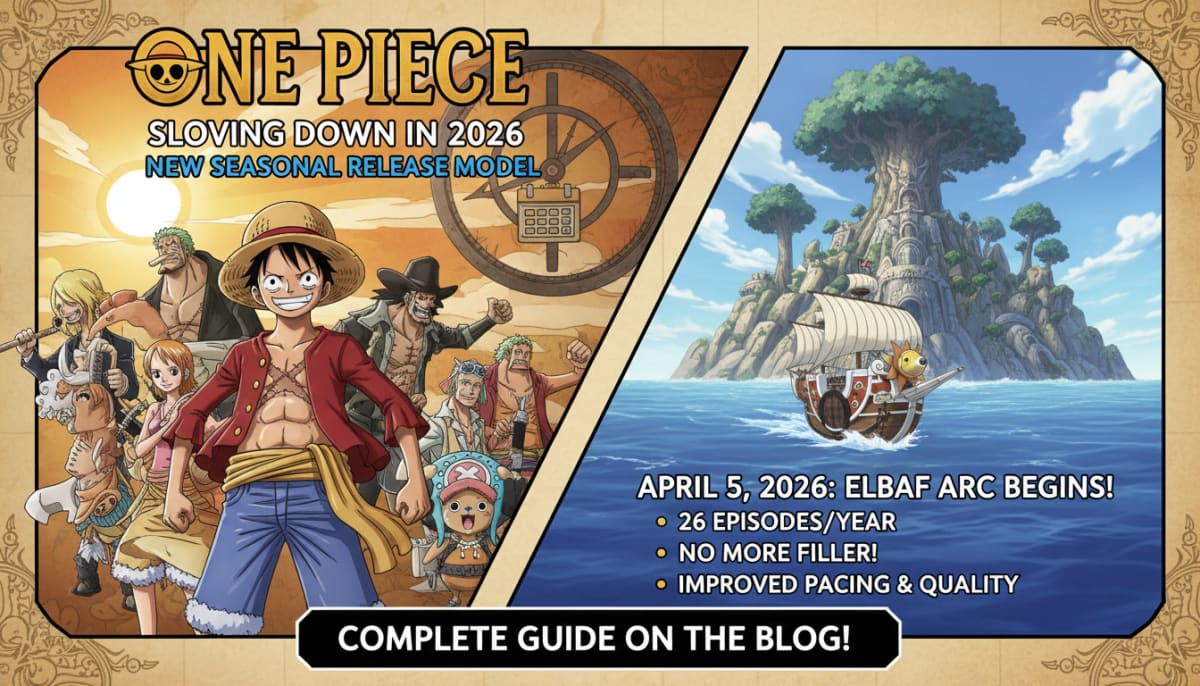
One Piece "Slowing Down" in 2026: Understanding the New Seasonal Release Model and Its Impact on Filler
In 2026, the One Piece anime will transition from its 26-year continuous weekly broadcast to a seasonal release model, marking one of the most significant changes in the series' history. This shift, officially announced by Toei Animation, aims to elevate production quality, align more closely with the manga's final saga, and eliminate the traditional filler episodes that have been a part of the series for decades. This comprehensive 3,500+ word guide covers everything you need to know about the 2026 transition, from the three-month hiatus following Episode 1155's conclusion of the Egghead Arc on December 28, 2025, to the April 5, 2026 return with the highly anticipated Elbaf Arc, and the new production schedule that will release a maximum of 26 episodes per year.
Whether you're a longtime One Piece fan who has followed the series since its 1999 debut, someone who has been frustrated by filler episodes and slow pacing, an anime enthusiast interested in industry trends, or a newcomer curious about the series' future, this guide provides complete coverage of the seasonal model transition, the impact on filler content, the improved pacing that will see each episode adapt approximately one full manga chapter, the focus on "movie-level" animation quality, and how this change positions One Piece for its final saga. We'll explore why Toei Animation made this decision, what it means for fans, how it compares to other long-running series that have made similar transitions, and what to expect from the Elbaf Arc premiere and beyond.
We'll also examine the broader context of One Piece in 2026, including the Netflix Live-Action Season 2 premiere on March 10, 2026, covering arcs from Loguetown through Drum Island, and the rumored Wit Studio remake project that remains in development as a separate entity from the original Toei series. Understanding these changes helps fans appreciate why this transition matters, how it will improve the viewing experience, and what it means for the future of one of anime's most iconic series.
Why The 2026 Transition Matters: The End of an Era
The transition to a seasonal release model represents more than just a scheduling change—it marks the end of a 26-year era of continuous weekly broadcasts that made One Piece one of the longest-running anime series in history. Since its debut in 1999, One Piece has maintained a consistent weekly schedule, adapting Eiichiro Oda's manga while incorporating filler episodes to prevent the anime from catching up to the source material. This approach, while successful in maintaining the series' presence on television, often resulted in slower pacing and episodes that adapted less than one full manga chapter.
For fans who have followed the series for years, the transition to a seasonal model addresses long-standing concerns about pacing and filler content. The new schedule, which will release a maximum of 26 episodes per year (roughly half the previous output of ~50 episodes annually), allows the production team to focus on quality over quantity, ensuring that each episode receives the attention and resources needed to deliver "movie-level" animation and deeper world-building. This shift is particularly significant as the series enters its final saga, where every moment matters and the stakes are higher than ever.
The three-month hiatus from January to March 2026, following the conclusion of the Egghead Arc with Episode 1155 on December 28, 2025, provides the production team with valuable time to prepare for the Elbaf Arc and establish the new seasonal format. This break, while unprecedented in the series' history, is essential for ensuring a smooth transition and maintaining the high quality standards that fans expect from the final saga.
Quick Navigation
Click to jump directly to a section:
- 1. The 2026 Schedule: Hiatus & Return
- 2. Seasonal Structure: 26 Episodes Per Year
- 3. Elimination of Traditional Filler
- 4. Improved Pacing: One Chapter Per Episode
- 5. Production Quality: Movie-Level Animation
- 6. Elbaf Arc: The April 2026 Return
- 7. Why This Transition Was Necessary
- 8. Impact on Fans: What Changes
- 9. Industry Context: Other Series Transitions
- 10. Related Projects: Live-Action & Remake
- 11. FAQ: Common Questions
- 12. Future Outlook: Why This Matters
1. The 2026 Schedule: Hiatus & Return
The 2026 transition begins with a three-month production break from January to March 2026, following the conclusion of the Egghead Arc with Episode 1155 on December 28, 2025. This hiatus is unprecedented in One Piece's 26-year history, marking the first extended break in the series' continuous weekly broadcast schedule. The break serves multiple purposes: providing the production team with time to prepare for the new seasonal format, allowing for quality improvements in animation and production values, and building anticipation for the series' return with the Elbaf Arc.
Initial Hiatus: January–March 2026
The three-month break includes:
- Start Date: January 2026 (following Episode 1155 on December 28, 2025)
- Duration: Three months (January, February, March)
- Purpose: Production preparation and quality improvement
- Unprecedented: First extended break in 26-year history
- Necessary: Essential for smooth transition to seasonal format
Return Date: April 5, 2026
The series returns with:
- Date: April 5, 2026
- Arc: Elbaf Arc premiere (Episode 1156)
- Format: Beginning of seasonal release model
- Quality: Improved production values and pacing
- Anticipation: Highly anticipated return after hiatus
Why This Schedule Works
The timing is strategic because:
- Arc Conclusion: Natural break point after Egghead Arc
- Preparation Time: Adequate time for production team
- Quality Focus: Allows for improved animation and pacing
- Fan Anticipation: Builds excitement for return
- Seasonal Positioning: Strong release window in April
2. Seasonal Structure: 26 Episodes Per Year
Starting in 2026, the One Piece anime will release a maximum of 26 episodes per year, typically split into two "cours" (two parts) of approximately 13 episodes each. This represents a significant reduction from the previous output of ~50 episodes annually, roughly halving the episode count while focusing on quality over quantity. The seasonal structure allows for better production planning, higher animation quality, and more consistent pacing that aligns with the manga's release schedule.
Annual Episode Count
The new schedule includes:
- Maximum Episodes: 26 episodes per year
- Previous Output: ~50 episodes annually (roughly halved)
- Split Format: Two cours of approximately 13 episodes each
- Quality Focus: Fewer episodes allow for better production
- Consistent Schedule: Predictable release pattern
Two-Cour Structure
The annual schedule is divided into:
- First Cour: Approximately 13 episodes (typically spring/summer)
- Second Cour: Approximately 13 episodes (typically fall/winter)
- Break Between: Production break between cours
- Flexibility: Allows for adjustments based on manga progress
- Quality Assurance: Adequate time for production between cours
Why 26 Episodes Per Year?
This number is strategic because:
- Manga Alignment: Matches manga release schedule better
- Quality Balance: Allows for high-quality production
- Pacing Control: Prevents catching up to source material
- Production Efficiency: Manageable workload for staff
- Industry Standard: Common for seasonal anime series
3. Elimination of Traditional Filler
One of the most significant changes in the 2026 transition is the elimination of traditional filler episodes—content created solely to prevent the anime from catching up to the manga. For decades, One Piece has incorporated filler arcs and episodes to maintain a buffer between the anime and manga, often resulting in storylines that don't appear in the source material and can disrupt the narrative flow. The seasonal model eliminates the need for this filler content, allowing the series to focus exclusively on adapting Eiichiro Oda's manga.
What Was Filler?
Traditional filler included:
- Filler Arcs: Entire storylines not in the manga
- Filler Episodes: Individual episodes with original content
- Extended Scenes: Stretched-out moments from manga
- Pacing Filler: Slow pacing to avoid catching up
- Recap Episodes: Episodes summarizing previous content
Why Filler Existed
Filler was necessary because:
- Weekly Schedule: Needed constant content
- Manga Buffer: Prevented catching up to source material
- Production Constraints: Limited time for adaptation
- Broadcast Requirements: Weekly television slot needed content
- Economic Factors: Continuous production model
How Seasonal Model Eliminates Filler
The new approach eliminates filler by:
- Controlled Release: Only 26 episodes per year
- Manga Alignment: Better synchronization with source material
- Production Planning: Adequate time between cours
- Quality Focus: Emphasis on adaptation quality over quantity
- No Catch-Up Pressure: Reduced risk of catching up to manga
4. Improved Pacing: One Chapter Per Episode
One of the most significant improvements in the 2026 seasonal model is the improved pacing that will see each episode consistently adapt approximately one full manga chapter. This represents a major change from the previous slower pacing that often adapted less than one chapter per episode, resulting in stretched-out scenes, extended reaction shots, and slower narrative progression. The new pacing ensures that each episode covers meaningful story content while maintaining the quality and detail that fans expect.
Previous Pacing Issues
The old pacing often featured:
- Less Than One Chapter: Episodes adapting partial chapters
- Extended Scenes: Stretched-out moments and reactions
- Slow Progression: Minimal story advancement per episode
- Repetitive Content: Repeated scenes and dialogue
- Frustration: Fan complaints about slow pacing
New Pacing Approach
The improved pacing includes:
- One Chapter Per Episode: Consistent adaptation ratio
- Meaningful Content: Each episode covers substantial story
- Better Flow: Natural narrative progression
- Reduced Stretching: Less padding and extended scenes
- Fan Satisfaction: More story per episode
Why This Pacing Matters
Improved pacing benefits:
- Story Quality: Better narrative flow and progression
- Fan Experience: More satisfying viewing experience
- Manga Fidelity: Closer adaptation to source material
- Engagement: Maintains viewer interest and excitement
- Final Saga: Essential for high-stakes final saga content
5. Production Quality: Movie-Level Animation
With fewer episodes produced annually, the production team has more time and resources to focus on "movie-level" animation and deeper world-building, ensuring that the Final Saga receives the highest production values possible. This quality focus represents a significant shift from the previous model, where the need to produce ~50 episodes annually often resulted in inconsistent animation quality and limited time for detailed work. The seasonal model allows for better resource allocation, more attention to detail, and higher overall production standards.
Quality Improvements
The new model enables:
- Movie-Level Animation: Higher quality animation standards
- Detailed Work: More time for intricate animation
- Consistent Quality: Higher standards across all episodes
- World-Building: Deeper exploration of settings and characters
- Visual Excellence: Enhanced visual presentation
Resource Allocation
Better resource management includes:
- Time Investment: More time per episode for production
- Staff Focus: Better distribution of work and talent
- Budget Efficiency: More budget per episode
- Quality Control: Better oversight and quality assurance
- Creative Freedom: More room for creative expression
Why Quality Matters for Final Saga
High production values are essential because:
- High Stakes: Final saga has significant story importance
- Fan Expectations: Fans expect quality for conclusion
- Legacy: Final saga will be remembered and rewatched
- Competition: Competing with other high-quality anime
- Cultural Impact: One Piece's conclusion is culturally significant
6. Elbaf Arc: The April 2026 Return
The series returns on April 5, 2026, with the start of the highly anticipated Elbaf Arc, marking the beginning of the new seasonal format and the continuation of the Final Saga. The Elbaf Arc has been long-teased in the series, with references dating back over 20 years, making it one of the most anticipated arcs in One Piece history. The arc will feature the Straw Hat Pirates arriving at the legendary homeland of the Giants, introducing major new characters including the long-teased Prince Loki, and exploring themes of war, legacy, and the path to Laugh Tale.
Elbaf Arc Significance
The arc is significant because:
- Long-Teased: Referenced in series for over 20 years
- Giants' Homeland: Legendary location in One Piece world
- Major Characters: Introduction of Prince Loki and others
- Final Saga: Pivotal chapter in series conclusion
- High Stakes: Important for path to Laugh Tale
What to Expect
The arc will feature:
- Viking-Inspired Attire: Crew in new visual designs
- New Characters: Prince Loki and other major figures
- World-Building: Exploration of Giants' culture and history
- Action Sequences: High-quality animation and battles
- Story Progression: Advancement toward series conclusion
Why This Arc Matters for Seasonal Model
The Elbaf Arc premiere demonstrates:
- Quality Standards: Showcases new production values
- Improved Pacing: Better story progression per episode
- No Filler: Focus on manga content exclusively
- Fan Satisfaction: Delivers on long-awaited arc
- Model Validation: Proves effectiveness of seasonal format
7. Why This Transition Was Necessary
The transition to a seasonal release model was necessary for multiple reasons, including the need to improve production quality, eliminate filler content, align better with the manga's release schedule, and ensure that the Final Saga receives the attention and resources it deserves. After 26 years of weekly broadcasts, the series had reached a point where changes were needed to maintain quality and satisfy fan expectations, particularly as the story approaches its conclusion.
Production Quality Concerns
Quality issues necessitated change:
- Inconsistent Animation: Varying quality across episodes
- Time Constraints: Limited time for detailed work
- Resource Limitations: Spread thin across many episodes
- Fan Complaints: Concerns about animation quality
- Competition: Other series with higher production values
Pacing & Filler Problems
Pacing issues required addressing:
- Slow Pacing: Episodes adapting less than one chapter
- Filler Content: Unnecessary episodes disrupting flow
- Fan Frustration: Complaints about slow progression
- Manga Comparison: Anime falling behind in quality
- Final Saga Needs: High-stakes content requires better pacing
Final Saga Requirements
The final saga demands:
- High Quality: Best production values for conclusion
- Consistent Pacing: Proper story progression
- No Filler: Focus on essential story content
- Fan Satisfaction: Deliver quality conclusion
- Legacy: Ensure series ends on high note
8. Impact on Fans: What Changes
For fans, the transition to a seasonal release model brings both changes and improvements. While the reduced episode count means fewer episodes per year, the improvements in quality, pacing, and the elimination of filler content create a better overall viewing experience. Understanding these changes helps fans appreciate why the transition was necessary and what to expect from the new format.
What Fans Gain
Fans benefit from:
- Better Quality: Higher animation and production standards
- Improved Pacing: More story content per episode
- No Filler: Focus on manga content exclusively
- Consistent Schedule: Predictable release pattern
- Better Experience: More satisfying viewing overall
What Fans Adjust To
Fans need to adapt to:
- Fewer Episodes: 26 per year instead of ~50
- Seasonal Breaks: Gaps between cours
- No Weekly Episodes: End of continuous weekly schedule
- Patience Required: Waiting for new episodes
- Schedule Changes: Different release timing
Overall Impact
The overall impact is:
- Positive: Quality improvements outweigh reduced quantity
- Necessary: Changes needed for series' future
- Beneficial: Better experience for fans
- Forward-Looking: Positions series for strong conclusion
- Worthwhile: Trade-off of quantity for quality is valuable
9. Industry Context: Other Series Transitions
One Piece is not the first long-running anime series to transition from weekly to seasonal formats. Other series, including Dragon Ball Super, Naruto, and Bleach, have made similar transitions, demonstrating that this approach can be successful for maintaining quality while adapting to changing industry standards and fan expectations. Understanding how other series have handled similar transitions provides context for One Piece's change.
Similar Transitions
Other series that transitioned include:
- Dragon Ball Super: Moved to seasonal format for quality
- Naruto: Transitioned to seasonal for Boruto series
- Bleach: Returned as seasonal for Thousand-Year Blood War
- Industry Trend: Growing preference for seasonal formats
- Quality Focus: Emphasis on production quality
Why This Trend Exists
The industry trend toward seasonal formats reflects:
- Quality Standards: Higher expectations for animation
- Production Efficiency: Better resource management
- Fan Preferences: Audience demand for quality
- Manga Alignment: Better synchronization with source material
- Economic Factors: More sustainable production models
One Piece's Unique Position
One Piece's transition is notable because:
- 26-Year History: Longest continuous weekly run
- Cultural Significance: Major cultural and commercial impact
- Final Saga: Transition during conclusion
- High Expectations: Fan expectations for quality conclusion
- Industry Influence: May influence other long-running series
10. Related Projects: Live-Action & Remake
In addition to the anime's transition to a seasonal model, 2026 also features other One Piece projects that contribute to the franchise's presence. The Netflix Live-Action Season 2 premieres globally on March 10, 2026, covering arcs from Loguetown through Drum Island, while the rumored Wit Studio remake project remains in development as a separate entity from the original Toei series. These projects demonstrate the franchise's continued expansion and appeal across different media formats.
Netflix Live-Action Season 2
The live-action series includes:
- Premiere Date: March 10, 2026
- Platform: Netflix (global release)
- Content: Loguetown through Drum Island arcs
- Separate Project: Independent from anime series
- Fan Interest: High anticipation following Season 1 success
Wit Studio Remake
The remake project features:
- Status: In development (rumored 2026 release)
- Studio: Wit Studio (Attack on Titan, Spy x Family)
- Format: Separate from original Toei series
- Purpose: Modern retelling of early arcs
- Uncertainty: Release date not confirmed
Franchise Expansion
These projects demonstrate:
- Media Diversity: Multiple formats and adaptations
- Global Appeal: International audience interest
- Franchise Strength: Continued commercial success
- Creative Innovation: Different approaches to same source
- Fan Engagement: Multiple ways to experience One Piece
11. FAQ: Common Questions
Here are answers to frequently asked questions about One Piece's transition to a seasonal release model:
Q1: When does One Piece return in 2026?
A: One Piece returns on April 5, 2026, with the premiere of the Elbaf Arc (Episode 1156), following a three-month hiatus from January to March 2026.
Q2: How many episodes will One Piece release per year?
A: Starting in 2026, One Piece will release a maximum of 26 episodes per year, typically split into two cours of approximately 13 episodes each. This is roughly half the previous output of ~50 episodes annually.
Q3: Will there be filler episodes in the new format?
A: No, the seasonal model is designed to eliminate traditional filler episodes. With only 26 episodes per year and better alignment with the manga release schedule, there is no need for filler content to prevent catching up to the source material.
Q4: How will pacing improve?
A: Each episode will now consistently adapt approximately one full manga chapter, a significant improvement from the previous slower pacing that often adapted less than one chapter per episode. This ensures more meaningful story content per episode.
Q5: Why did One Piece transition to a seasonal model?
A: The transition was necessary to improve production quality, eliminate filler content, align better with the manga's release schedule, and ensure that the Final Saga receives the highest production values possible. After 26 years of weekly broadcasts, changes were needed to maintain quality and satisfy fan expectations.
Q6: What happens during the three-month hiatus?
A: The hiatus from January to March 2026 allows the production team to prepare for the new seasonal format, improve animation quality, and build anticipation for the Elbaf Arc premiere. This is the first extended break in the series' 26-year history.
Q7: Will the animation quality improve?
A: Yes, with fewer episodes produced annually, the production team has more time and resources to focus on "movie-level" animation and deeper world-building, ensuring higher production values across all episodes.
Q8: How does this compare to other long-running series?
A: One Piece follows a trend seen in other long-running series like Dragon Ball Super, Naruto, and Bleach, which have also transitioned to seasonal formats to maintain quality and better align with source material. This approach has proven successful for maintaining production standards.
Q9: What about the Netflix Live-Action series?
A: The Netflix Live-Action Season 2 is a separate project that premieres on March 10, 2026, covering arcs from Loguetown through Drum Island. It is independent from the anime series and does not affect the anime's seasonal transition.
Q10: Is the Wit Studio remake still happening?
A: The Wit Studio remake project remains in development, with a rumored 2026 release, but it is a separate project from the original Toei series. It would be a modern retelling of early arcs, independent from the ongoing Toei anime.
12. Future Outlook: Why This Matters
The transition to a seasonal release model represents more than just a scheduling change—it is a strategic decision that positions One Piece for a strong conclusion to its Final Saga while addressing long-standing fan concerns about quality, pacing, and filler content. The 2026 transition, with its focus on quality over quantity, improved pacing, and elimination of filler, ensures that the series' conclusion receives the attention and resources it deserves, creating a better experience for fans and a stronger legacy for one of anime's most iconic series.
Long-Term Benefits
This transition provides:
- Quality Legacy: High-quality conclusion for the series
- Fan Satisfaction: Better experience for viewers
- Industry Impact: May influence other long-running series
- Cultural Significance: Proper conclusion for iconic series
- Future Potential: Positions franchise for continued success
What Success Looks Like
Success would mean:
- Quality Standards: Consistent high-quality animation
- Fan Approval: Positive reception from viewers
- Smooth Transition: Successful adaptation to new format
- Strong Conclusion: Satisfying end to Final Saga
- Industry Recognition: Acknowledgment of quality improvements
Why This Transition Was Inevitable
The change was necessary because:
- Quality Demands: Fan expectations for better production
- Final Saga Needs: High-stakes content requires quality
- Industry Trends: Movement toward seasonal formats
- Economic Factors: More sustainable production model
- Creative Requirements: Better conditions for creative work
Conclusion: The End of an Era, The Beginning of Quality
One Piece's transition to a seasonal release model in 2026 marks the end of a 26-year era of continuous weekly broadcasts and the beginning of a new approach focused on quality, pacing, and fan satisfaction. The three-month hiatus from January to March 2026, followed by the April 5, 2026 return with the Elbaf Arc, represents a strategic shift that addresses long-standing concerns while positioning the series for a strong conclusion to its Final Saga.
From the elimination of traditional filler episodes and the improved pacing that will see each episode adapt approximately one full manga chapter, to the focus on "movie-level" animation and the new schedule of 26 episodes per year split into two cours, the 2026 transition creates a better viewing experience that prioritizes quality over quantity. This change, while requiring adjustment from fans accustomed to weekly episodes, ultimately serves the series' best interests and ensures that the Final Saga receives the attention and resources it deserves.
Whether you're a longtime One Piece fan who has followed the series for years, someone who has been frustrated by filler and slow pacing, an anime enthusiast interested in industry trends, or a newcomer curious about the series' future, the 2026 transition represents a positive change that will improve the overall quality of the anime while maintaining the storytelling and character development that have made One Piece one of the most beloved series in anime history. The end of the weekly format may mark the end of an era, but it also marks the beginning of a new chapter focused on delivering the highest quality possible for the series' conclusion.
More than just a scheduling change, One Piece's transition to a seasonal model validates the value of quality over quantity, demonstrates the effectiveness of adapting to fan feedback and industry standards, and showcases how long-running series can evolve to meet changing expectations while maintaining their core identity. The commitment to quality, the elimination of filler, and the improved pacing all demonstrate the dedication to excellence that makes this transition so significant. Mark your calendars for April 5, 2026, and prepare to experience One Piece in a new format—one that promises to deliver the quality, pacing, and storytelling that the Final Saga deserves.