
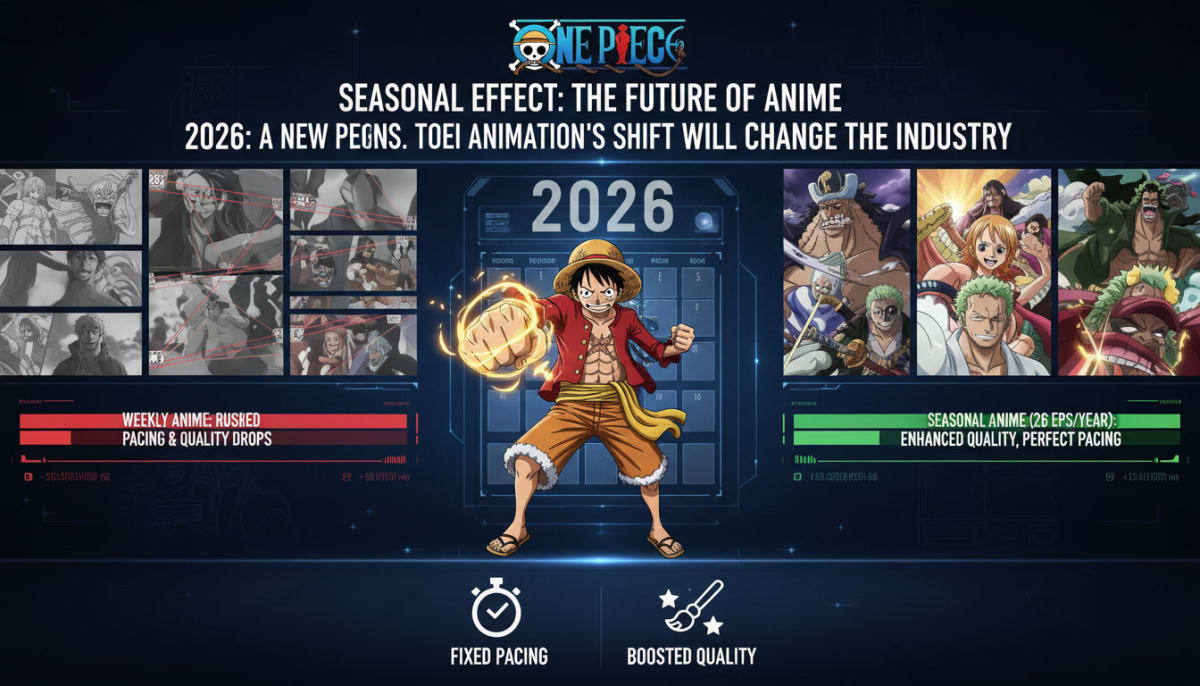
The "One Piece" Seasonal Effect: Is the End of Weekly Anime Better for the Industry?
When I first tried to get into One Piece years ago, I hit a wall: hundreds of episodes, endless stretches where nothing seemed to happen, and fights that dragged for dozens of installments. I wanted to experience the story everyone raves about—Luffy, the Straw Hats, the world-building—but the sheer length and the infamous pacing made it feel like a part-time job. I kept thinking: what if the anime could breathe instead of rushing to fill a slot every single week? That's exactly what Toei Animation is doing in 2026. After more than 1,100 episodes and 26 years of non-stop weekly broadcasts, One Piece is switching to a seasonal release model. In this guide, I break down why that matters for fans, for the industry, and for anyone who's ever been intimidated by the show's size.
If you've been following anime news 2026 or One Piece news, you've likely seen the headlines: the Egghead Arc wrapped in late 2025, the series went on a three-month production break from January to March 2026, and it returns in April with the Elbaph Arc under a new format—a maximum of 26 episodes per year, split into two cours. Fewer episodes means more focused storytelling, better animation, and finally tackling the pacing and filler issues that have plagued the adaptation. Whether you're a longtime fan, someone who dropped the anime for the manga, or a newcomer curious about the One Piece 2026 release schedule, this piece covers the One Piece seasonal anime shift, what it fixes, and what it could mean for the future of long-running anime.
Quick Navigation
Click to jump directly to a section:
- Why One Piece Is Going Seasonal in 2026
- The 2026 Production Breakdown
- How the Seasonal Format Fixes Pacing
- Weekly vs. Seasonal Anime: What Actually Changes
- Why This Matters for the Anime Industry
- The Elbaph Arc and What Comes Next
- FAQ: One Piece 2026 Seasonal Shift
Why One Piece Is Going Seasonal in 2026
The word "filler" has haunted anime fandom for decades. Filler episodes are those not directly adapted from the source manga—originals created to buy time while the manga advances. Big names like Dragon Ball Z, Naruto, and Bleach all ran weekly for years, caught up to their source material, and padded their runs with arcs that many fans skip. One Piece avoided full filler arcs better than most, but the weekly model forced another problem: pacing. To avoid overtaking the manga, the anime often stretched a single chapter across an entire episode. Fights dragged, reaction shots repeated, and even quiet moments felt elongated. It's one of the main reasons fans recommend the manga over the anime to newcomers.
Toei Animation has now decided to change that. The move to a seasonal anime format—announced for 2026—is a direct response to pacing and quality. Producer Ryuta Koike described it as a strategic decision to support the advancement and evolution of the series, with new episodes designed to match the manga's tempo and context more closely. The Egghead Island arc already showed what the team can do with slightly more room: standout episodes, stronger art direction, and sequences that feel like deliberate adaptations rather than padded content. The One Piece seasonal anime shift builds on that and makes it the default.
The 2026 Production Breakdown
Understanding the One Piece 2026 release schedule means nailing a few concrete dates and numbers. Here's the breakdown.
When Did the Weekly Era End?
Episode 1155 concluded the Egghead Arc on December 28, 2025. That was the last episode of the classic weekly era. After that, the show went on hiatus.
The Toei Animation 2026 Production Break
From January to March 2026, there were no new One Piece anime episodes. This One Piece hiatus 2026 gave the production team time to restructure, retool, and prepare for the new format. It's the first extended break the anime has taken in over a quarter of a century.
The New Format: Two Cours, 26 Episodes Max
Starting April 5, 2026, the series returns with a two-cour annual schedule. Output is capped at a maximum of 26 episodes per year—roughly two batches of 13 episodes—instead of the old 45–50. If you've been asking how many episodes of One Piece in 2026?, the answer is: no more than 26.
The One Piece Elbaph Arc Start Date
The return arc is Elbaph, part of the manga's final saga. The One Piece Elbaph Arc start date in the anime is April 5, 2026. The first episode in the new format will effectively be One Piece episode 1156, and fans have been marking that date as the real start of the "seasonal" era.
How the Seasonal Format Fixes Pacing
Historically, the anime adapted somewhere between half a chapter and a little under one chapter per episode. That meant stretches of recycled reaction shots, prolonged stares, and fights that in the manga lasted a few pages but on screen spanned multiple episodes. The seasonal model flips the script: the target is closer to one chapter per episode. That tighter ratio alone reduces padding and lets arcs move at a pace that respects both the source material and the viewer's time.
Fewer episodes per year also means less pressure to churn out content every week. The team can prioritize key moments, invest in sharper animation and direction, and avoid the burnout that has plagued long-running productions. The Egghead arc already demonstrated that when the staff gets a bit more breathing room, the result can be some of the best One Piece anime in years. The 2026 format is designed to make that the norm, not the exception.
Weekly vs. Seasonal Anime: What Actually Changes
A simple comparison helps clarify the shift.
- Annual episode count: The weekly era typically delivered 45–50 episodes per year. The new model caps at 26 episodes per year.
- Manga pacing: Before, the anime often used roughly 0.5 to 0.8 chapters per episode. Now the aim is around 1.0 chapter per episode, or better.
- Animation consistency: Weekly production led to ups and downs, especially when filler or padding kicked in. The seasonal approach allows for more consistent, higher-tier animation, closer to the "cinema-level" quality seen in series like Demon Slayer or Jujutsu Kaisen.
- Staff workload: The old model was a non-stop grind. The new one uses structured cycles with breaks, which matters for talent retention and long-term sustainability.
So when we ask weekly vs. seasonal anime: which is better for pacing?, the 2026 One Piece experiment is a clear bet on seasonal. It won't undo the past, but it sets a new standard for what the rest of the run can be.
Why This Matters for the Anime Industry
The One Piece change is part of a bigger anime industry trend. For years, the biggest manga often got endless weekly anime—Dragon Ball, Naruto, Bleach. Today, many of the highest-profile shows are seasonal: shorter orders, often higher production values, and built-in hype cycles. Attack on Titan and Demon Slayer helped redefine expectations. If a titan like One Piece can step away from the weekly format, it signals that the era of "weekly at all costs" is winding down.
There are practical forces at play too. The industry faces labor shortages and tough working conditions; reports of animators earning below 200,000 yen per month remain a concern. Moving away from a relentless weekly grind can make production more sustainable. Toei has also invested in new tools and technology—including AI-assisted production—to support the shift. The goal isn't just better One Piece; it's a more viable model for marquee titles.
Seasonal breaks also create clear "event" windows. Marketing teams can build hype around returns, tie-in merchandise, and cross-promotion. The One Piece live-action series, for example, is set to return in early 2026, with Season 2 premiering during the anime's hiatus—keeping the brand in the spotlight even when no new episodes are airing. That kind of coordination is harder when a show never stops.
The Elbaph Arc and What Comes Next
The Elbaph Arc is one of the most anticipated stretches of the manga's final saga. The anime comeback on April 5, 2026 will reintroduce the series in its new format, and expectations are high. Fans who have waited through the One Piece hiatus 2026 will finally see how the seasonal approach handles a major arc from start to finish.
There is also the WIT Studio and Netflix remake, The One Piece, which will re-adapt the story from the beginning in a separate continuity. Rather than competing with that project, Toei's seasonal pivot ensures the main One Piece anime remains the flagship adaptation for the current story. The long-running show isn't stepping aside; it's evolving to stay relevant and to give the final saga the treatment it deserves.
For anime release dates and anime season 2026 watchers, the One Piece 2026 release schedule is now a fixed reference: a defined hiatus, a defined return, and a predictable rhythm of roughly 26 episodes per year. That clarity alone is a win for anyone planning their watch schedule or trying to onboard new fans who were once put off by four-digit episode counts.
FAQ: One Piece 2026 Seasonal Shift
Is One Piece anime ending in 2026?
No. The anime is not ending in 2026. It is simply shifting from a weekly to a seasonal format with 26 episodes per year to ensure higher quality for the final saga.
When does the One Piece Elbaph Arc start in the anime?
The Elbaph Arc is scheduled to premiere on April 5, 2026, following the three-month production break from January to March 2026.
How many episodes of One Piece will release in 2026?
Under the new model, One Piece will release a maximum of 26 episodes per year. The exact count for 2026 depends on production, but it will not exceed 26.
What was the last weekly One Piece episode?
Episode 1155, which concluded the Egghead Arc, aired on December 28, 2025. That was the final episode of the weekly era.
Why is One Piece going seasonal in 2026?
Toei Animation is switching to a seasonal format to improve pacing, reduce filler, and raise animation quality. The new structure allows roughly one manga chapter per episode and gives the staff sustainable production cycles.
Conclusion: A New Era for One Piece and Anime
The One Piece seasonal shift in 2026 is a milestone—for the series, for Toei, and for the anime industry. After 26 years of weekly broadcasts, the show is betting on fewer episodes, better pacing, and a format that has already proven itself with titles like Demon Slayer and Jujutsu Kaisen. For fans who have always wanted to dive in but were put off by length and pacing, the new model could finally make the anime as inviting as the manga. For those who have been here from the start, it's a chance to see the final saga animated the way it was meant to be.
Whether you follow anime news, anime release dates, or One Piece specifically, 2026 is the year to watch. The One Piece 2026 release schedule is set: hiatus until April, then the Elbaph Arc under a new, leaner format. The end of weekly One Piece isn't the end of the journey—it's the start of a more focused one.
Last updated: February 2026 | One Piece anime returns April 5, 2026 with the Elbaph Arc