
How WIT Studio and MAPPA Are Redefining "Peak Fiction" Quality in 2026
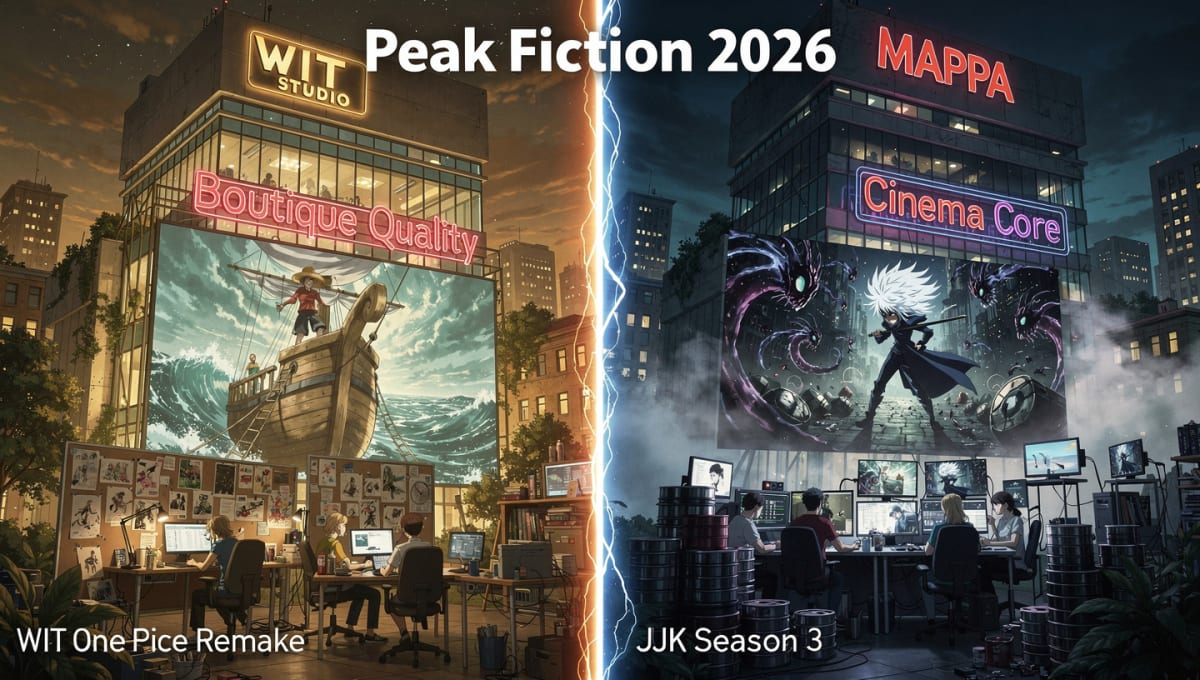
I watched Jujutsu Kaisen Season 2 when it aired and I remember the debates: the action was incredible, but the dimming drove people crazy. Scenes that should have popped felt oddly dark, and I kept thinking the screen was too dim—until I learned it was a deliberate broadcast choice. When I went back to Attack on Titan's early seasons, I noticed something else entirely: WIT Studio had given the show a consistent, almost film-like look from start to finish. No sudden drops, no weird darkening. Just clean, dynamic animation. Fast-forward to 2026, and I've been tracking how these two studios—WIT and MAPPA—are defining "peak" anime in completely different ways. MAPPA is pushing what I'd call "Cinema-Core": every Jujutsu Kaisen Season 3 episode feels like a theatrical cut. WIT is doubling down on what I think of as "Heritage & Harmony"—taking legacy IPs like One Piece and giving them a prestige makeover with lush art and a Director-First approach. In this piece, I break down how each studio is redefining Peak Fiction 2026, why fans are divided over the new "peak" aesthetic, and what it means for anime production trends 2026.
If you've been following anime studio news 2026 or jujutsu kaisen news, you've likely seen the headlines: MAPPA is airing Jujutsu Kaisen Season 3 (Culling Game) and Hell's Paradise Season 2 at the same time in Winter 2026, and in January 2026 they signed a major strategic partnership with Netflix to co-develop original anime. WIT Studio, meanwhile, is leading The One Piece remake for Netflix—a full re-adaptation of the East Blue Saga—and has Ascendance of a Bookworm Season 4 premiering April 4, 2026. Both studios are using January 2026 to showcase two completely different versions of "Peak Fiction." I've spent the past few weeks comparing MAPPA vs WIT Studio 2026 output, and I think the split says a lot about where the industry is heading. Whether you care about JJK Season 3 animation quality, the WIT Studio One Piece remake, or just want to understand the anime industry shift, this guide covers the boutique approach vs the blockbuster approach, the technical upgrades, and why 2026 might be the year we stop agreeing on what "peak" even means.
Quick Navigation
Click to jump directly to a section:
- WIT Studio: The Quality & Consistency Leader
- MAPPA: The Cinema-Core Revolution
- WIT vs MAPPA 2026: How Their "Peak" Standards Compare
- Why Fans Are Divided Over the New Peak Aesthetic
- FAQ: WIT, MAPPA, and Peak Fiction 2026
WIT Studio: The Quality & Consistency Leader
I've always associated WIT Studio with consistency. When I rewatched Attack on Titan's first three seasons, I was struck by how even the "quieter" episodes held up—the background art, the character expressions, the sense of place. In 2026, WIT is redefining peak quality by moving toward seasonal formats that allow what I'd call "movie-quality" animation across entire series, not just climaxes. They're not trying to match MAPPA's raw output; they're betting on craft, collaboration, and a "boutique" feel.
The One Piece Remake: East Blue, No Filler
The project I'm most excited about is The One Piece remake. WIT is leading a total re-adaptation of One Piece for Netflix, starting with the East Blue Saga. I did a deep dive into the WIT Studio One Piece remake news and here's what stands out: they're ditching Toei's weekly model for a seasonal one. No filler, no padding—just consistent "sakuga" (peak animation) that used to be reserved for films. They're using a Paper-to-Digital Hybrid method, focusing on the expressive, rubbery physics of early Luffy. I think that's a deliberate contrast to Toei's modern, "aura-heavy" style. Fans are already comparing "Classic Luffy" to "WIT Luffy," and the WIT Studio One Piece remake release date chatter is everywhere. If you've ever wondered can WIT Studio truly surpass the original's legacy?—I don't know yet, but I think they're aiming for a different kind of win: clean, faithful, and visually distinct.
Bookworm, Apothecary, and the "Director-First" Model
Beyond One Piece, I've been keeping an eye on Ascendance of a Bookworm Season 4, which premieres April 4, 2026. WIT's work on Bookworm and projects like Agents of the Four Seasons shows their commitment to lush backgrounds and vibrant, detailed character designs. I prefer that over gritty realism for certain stories—it feels like each frame is considered. Their collaboration on The Apothecary Diaries content (and the upcoming movie) highlights what I'd call Environmental Storytelling: the costumes, the lighting of the palace, the intricate character expressions. MAPPA often focuses on action; WIT often focuses on atmosphere and place.
Under CEO George Wada, WIT has shifted to a Director-First model. Unlike MAPPA's "factory" style—multiple teams, high throughput—WIT tends to treat each project as a distinct piece of art. I've noticed that their 2026 shows don't all "look" the same; they feel like different directors' visions. That's the "Heritage & Harmony" approach: take legacy or existing IPs, give them a prestige makeover, and let the directors lead. It's a slower, more curated way of working, but I think it's why fans who care about consistency and craft keep coming back to WIT.
I've also seen people call WIT a "boutique" studio—fewer titles, more time per project, emphasis on creative autonomy. I think that fits. When I look at their 2026 slate—One Piece remake, Bookworm Season 4, Apothecary Diaries—each one feels like a deliberate choice, not just "what's next on the conveyor." That's the Quality & Consistency leader angle: they're not trying to dominate the anime release schedule; they're trying to dominate the "best-looking adaptation" conversation.
MAPPA: The Cinema-Core Revolution
MAPPA has moved away from traditional TV-style animation. In 2026, they're perfecting what I'd call Cinema-Core—the practice of making every weekly episode look like a theatrical film. I watched the first few Jujutsu Kaisen Season 3 episodes as they dropped in January 2026, and I was genuinely surprised. The "dimming" issue that plagued Season 2? Gone. Or at least vastly reduced. From what I've read, they're using a new Dynamic Lighting Engine that allows for brighter, more fluid sakuga during the high-stakes Culling Game colony battles. I didn't expect to care about lighting tech, but when you compare Season 2 and Season 3 side by side, the difference is obvious. Fans are calling the Maki vs Naoya fight the new gold standard for 2D action in 2026, and I get it. The choreography, the impact frames, the clarity—it feels like a movie.
The Winter 2026 Powerhouse Lineup
MAPPA is currently airing both Jujutsu Kaisen Season 3 (Culling Game) and Hell's Paradise Season 2 simultaneously in early 2026. I did a double-take when I saw the MAPPA 2026 schedule—running two flagship action shows at once is a level of concurrent output that few studios can match. I've been following both, and the consistency is impressive. JJK has that gritty, cinematic lighting; Hell's Paradise keeps the period aesthetic and the violence sharp. If you're into JJK Season 3 animation quality or Hell's Paradise's direction, the MAPPA Winter 2026 lineup is worth analyzing episode by episode.
The Netflix-MAPPA Deal (January 21, 2026)
On January 21, 2026, MAPPA officially signed a deep strategic partnership with Netflix to co-develop original anime. I think this is a big deal. The deal lets MAPPA act as an "independent" creative entity while using Netflix's global infrastructure for simultaneous worldwide releases. From what I've gathered, it also means "unlimited budget" access for specific series—they've been able to hire top-tier freelance animators from across the globe, which has diversified their art style beyond the "gritty" look of Chainsaw Man. So we're not just getting more MAPPA; we're getting more varied MAPPA. If you've been wondering how the Netflix-MAPPA deal of 2026 will change the way we watch anime?—I'd say we're already seeing it: bigger budgets, global day-and-date drops, and a studio that can afford to experiment.
Sub-Studios and Sustainability
After the controversies of 2023–2024—animator burnout, tight schedules—MAPPA's 2026 strategy involves Sub-Studios. They've decentralized: the team on Hell's Paradise Season 2 is entirely separate from the JJK team. I think that's a direct response to the crunch criticism. Splitting workloads and letting each crew own their show reduces the risk of the kind of burnout that made headlines a few years ago. MAPPA's "peak" is still defined by gritty realism, cinematic lighting, and improved 3D CGI integration that often rivals 2D in fluidity—but now they're trying to sustain that without breaking their staff. I'm cautiously optimistic. We'll see how it holds up across the full MAPPA 2026 schedule.
I've been comparing JJK Season 3 and Hell's Paradise Season 2 week to week, and I think the MAPPA Winter 2026 lineup is a useful litmus test. Jujutsu Kaisen leans into the Culling Game's colony battles—fast, brutal, lighting-heavy. Hell's Paradise leans into period drama, body horror, and a different color palette. Both feel "MAPPA," but they don't feel like the same team copy-pasting a style. If you're into anime reviews or anime rating news, the JJK Season 3 animation quality discourse alone is worth following. Fans are dissecting every sakuga cut, and the Maki vs Naoya fight has already become a reference point for "how good can TV anime look in 2026?" I didn't expect to care this much about lighting tech, but here we are.
WIT vs MAPPA 2026: How Their "Peak" Standards Compare
I put together a comparison to make sense of what I'm seeing. It's not about which studio is "better"—they're aiming at different targets. But if you're debating MAPPA vs WIT Studio 2026, this breakdown might help.
- Current major title: WIT — The One Piece remake (Netflix, East Blue). MAPPA — Jujutsu Kaisen Season 3 (Culling Game) and Hell's Paradise Season 2.
- Core aesthetic: WIT — Vibrant, clean, dynamic. Lush backgrounds, expressive characters, environmental storytelling. MAPPA — Gritty, realistic, cinematic. Heavy lighting, 3D integration, action-first.
- Release strategy: WIT — Strictly seasonal, limited output. Fewer shows, more time per project. MAPPA — High output, global simulcast. Multiple flagship shows per season.
- Key innovation: WIT — Remaking existing pillars (e.g. One Piece) with modern tech and a Director-First, Paper-to-Digital hybrid approach. MAPPA — Full-lifecycle IP ownership, global deals (e.g. Netflix), Sub-Studios for sustainability, Dynamic Lighting and Cinema-Core.
So when we ask why are fans divided over the new "peak" aesthetic?—I think it comes down to taste. Do you want boutique, consistent, "heritage" makeovers? That's WIT. Do you want blockbuster, cinema-style action and scale? That's MAPPA. Both are valid. I enjoy both. But they're not the same kind of "peak."
Why Fans Are Divided Over the New Peak Aesthetic
I've seen the arguments online. Some fans say MAPPA's Cinema-Core is the only "real" peak—that anything less than film-like action every week feels outdated. Others say WIT's approach is closer to "true" anime: hand-crafted, director-driven, with room for atmosphere and subtlety. I think both sides are reacting to something real. MAPPA pushed the ceiling for TV action; WIT pushed the ceiling for consistency and adaptation quality. In 2026, we're seeing those philosophies play out at the same time. JJK Season 3 and Hell's Paradise S2 are MAPPA's answer to "what does peak action look like?" The One Piece remake is WIT's answer to "what does peak adaptation look like?"
I don't think we have to pick one. I watched the Maki vs Naoya fight and I was blown away. I also can't wait to see WIT's East Blue. The fact that we're having this conversation—MAPPA vs WIT 2026, Peak Fiction 2026, anime production trends 2026—is proof that both studios are defining the standard. The "battle" isn't really about who wins; it's about what kind of anime we want more of. And in 2026, we're getting both.
FAQ: WIT, MAPPA, and Peak Fiction 2026
What is "Peak Fiction" in anime?
"Peak Fiction" is a fan term for anime that sets the highest bar for animation quality, direction, and production value. In 2026, WIT Studio and MAPPA are often cited as the two studios redefining that standard—WIT through boutique, director-led projects like the One Piece remake, MAPPA through Cinema-Core action in Jujutsu Kaisen Season 3 and Hell's Paradise Season 2.
How did MAPPA fix the JJK Season 2 dimming issue?
MAPPA reportedly introduced a new Dynamic Lighting Engine for Jujutsu Kaisen Season 3 (2026). This addresses the "dimming" complaints from Season 2 by allowing brighter, more fluid sakuga during action sequences. The Maki vs Naoya fight is often cited as a standout example of the improved lighting and clarity.
When is the WIT Studio One Piece remake releasing?
The One Piece remake, produced by WIT Studio for Netflix, will adapt the East Blue Saga in a seasonal format. An exact WIT Studio One Piece remake release date has not been officially confirmed for 2026, but the project is actively in production and heavily discussed in anime news 2026.
What is the Netflix-MAPPA deal?
On January 21, 2026, MAPPA signed a strategic partnership with Netflix to co-develop original anime. The deal gives MAPPA access to Netflix's global distribution and larger budgets for select projects, enabling worldwide simulcasts and hiring of top freelance talent.
Is MAPPA doing both JJK Season 3 and Hell's Paradise Season 2?
Yes. MAPPA is airing Jujutsu Kaisen Season 3 (Culling Game) and Hell's Paradise Season 2 simultaneously in Winter 2026. The studio uses separate Sub-Studio teams for each show to manage workload and maintain quality.
Can WIT Studio's One Piece remake surpass the original?
That's the big question. WIT isn't trying to replace Toei's long-running One Piece—they're offering a seasonal, filler-free East Blue adaptation with a distinct visual style (Paper-to-Digital Hybrid, "Classic Luffy" look). Whether it "surpasses" the original is subjective; many fans see it as a complementary take rather than a replacement. The WIT Studio One Piece remake is aimed at viewers who want a modern, consistent adaptation of the early saga.
Conclusion: Two Roads to Peak Fiction in 2026
WIT Studio and MAPPA are redefining "Peak Fiction" in 2026 through completely different philosophies. WIT bets on quality over quantity: the One Piece remake, Bookworm Season 4, Apothecary Diaries, and a Director-First, boutique approach. MAPPA bets on scale and spectacle: JJK Season 3, Hell's Paradise S2, the Netflix deal, Cinema-Core, and Sub-Studios to keep output high without burning out. I've enjoyed following both. I think the "battle" framing—MAPPA vs WIT 2026—is fun, but the real takeaway is that we're getting two distinct versions of "peak" at once. Whether you prefer the clean, vibrant craft of WIT or the gritty, cinematic punch of MAPPA, 2026 is the year both are firing on all cylinders.
If you follow anime studio news, jujutsu kaisen news, one piece news, or anime production trends 2026, keep an eye on the MAPPA 2026 schedule and the WIT Studio One Piece remake updates. The way we talk about "peak" anime is changing—and WIT and MAPPA are leading the conversation.
Last updated: February 2026 | JJK S3 & Hell's Paradise S2 airing Winter 2026; WIT One Piece remake in production